To bring more people to the polls—especially voters from underrepresented groups—and to make voting more flexible, California passed the Voter’s Choice Act (2016): VCA counties send a mail ballot to all voters while consolidating in-person options into fewer and larger “vote centers” available to any voter in the county. But so far, the VCA effects on voter turnout have been mixed. The statewide policy to send mail ballots to all voters as of the 2020 election likely muted the effect of the VCA relative to counties that did not adopt the system.
How did switching to the VCA affect different elections and voters?
To understand how the VCA affected turnout, we look at counties before and after they switched to the VCA and compare to control counties—counties with the VCA already in place or with traditional voting systems in both elections. We compare the difference in voter turnout for the 2018 midterm versus the 2022 midterm and the difference in turnout for the 2020 versus the 2024 presidential election.
Between the 2018 and 2022 midterms, turnout fell by about 1.5 percentage points more in VCA-switching counties than in control counties. The opposite was true between the 2020 and 2024 presidential elections: turnout was slightly better in VCA-switching counties.
Switching to the VCA appears to have hurt turnout among Latino voters and new young voters (ages 18 or 19) in the 2022 midterm. While turnout improved for VCA counties with the 2024 presidential election among most racial/ethnic groups and new young voters, it changed by far less than one percentage point, except among Black voters—who saw a large drop in turnout in 2024.
Turnout fell more in the 2022 midterm for new VCA counties but less in the 2024 presidential election
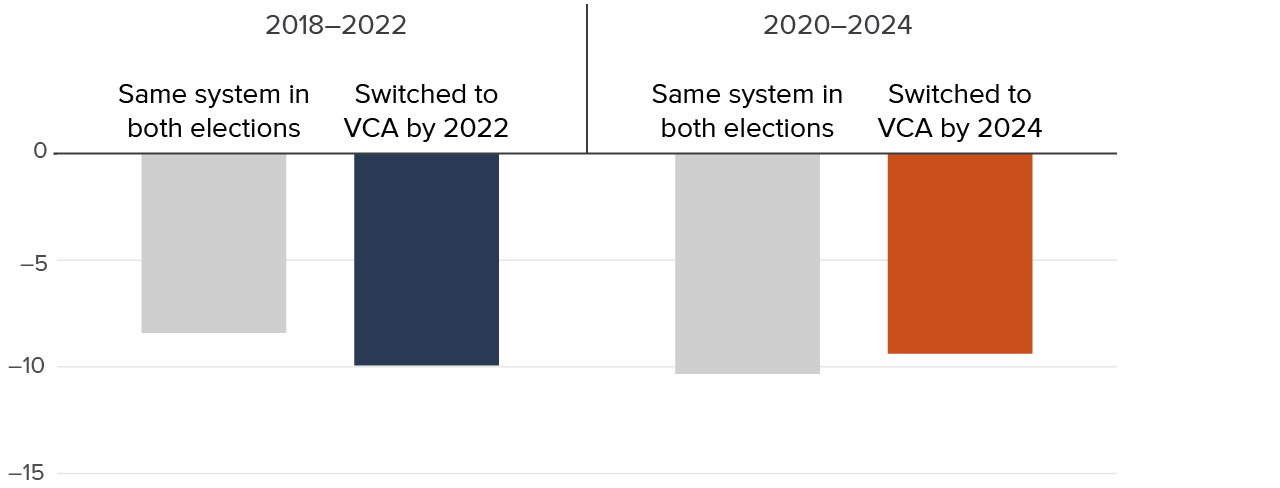
SOURCES: Political Data, Inc voter file, 2018 and 2020; VoteCal voter file, 2022 and 2024.
NOTE: Bars represent the average shift in turnout among individual voters between 2018 and 2022 and between 2020 and 2024. Five counties that were already using the VCA in 2018 (Madera, Napa, Nevada, Sacramento, and San Mateo) are omitted from the left plot but not the right.
Did changing the distance to where people could vote change turnout?
With in-person options consolidated, voters could now choose a convenient location besides their neighborhood polling place, such as a vote center near work or shopping. But consolidation also changed the distance people must travel to cast a ballot, typically placing it farther away than the site of their polling place under the old system.
We calculated how much the distance changed to the nearest polling place, vote center, or drop box from 2018 to 2022—and how that change affected voter turnout. Overall, distance did not have much effect on turnout in either VCA-switching or control counties—if anything, turnout was slightly higher at farther distances. The same conclusion largely held for racial/ethnic groups, though at the farthest distances Latino voters in VCA-switching counties did vote at lower rates than Latino voters at comparable distances in control counties.
We also examined the effect of distance for the new young voters. The patterns were very similar to those for older voters—distance had few consequences, and if anything, turnout climbed slightly for young voters farther away.
How much did experience with the VCA or voting history matter?
Spending more time under the VCA doesn’t seem to improve turnout. In fact, turnout in both the midterm and presidential election comparisons was often lower in counties with longer experience.
Experience with voting by mail sometimes had a bigger effect. Latino voters with a history of voting in person or who had voted less consistently over time were much less likely to vote in 2022 under VCA-switching counties, while Black voters with a more irregular voting history were much less likely to vote in VCA-switching counties in 2024. However, this negative effect was not universal: Asian American and Latino voters with an in-person history were somewhat more likely to vote in 2024.
What do these results mean for voter outreach and voting policy?
Given the results from 2022, the VCA system may at times be confusing for those who must adjust most to the new system: new voters and in-person voters. Targeted communication to these groups would likely help alleviate some of this confusion.
Yet, because distance to voting locations does not seem to affect turnout, adding more in-person sites may not influence whether people show up to cast a ballot. Every California voter now receives a mail ballot by default, so it may just be easier for voters to mail their ballots if distance becomes an obstacle. In fact, independent of in-person voting options, mailing every voter a ballot has been shown to elevate turnout and make the electorate more representative. It seems important to continue with the existing mail ballot policy even if some changes to in-person voting options are made.
California has made numerous changes to voter registration and updates to voting options, all with the goal of encouraging more voters to participate. Examining each reform to understand which approaches have worked and which have not can help the state further improve policies like the VCA going forward.
Topics
Political LandscapeLearn More
Changes to Voting Options Disrupted Turnout for Some Voters

California’s Voter Turnout Sank in 2024

Low-turnout Communities Have a Smaller Voice in California’s Democratic Process

Equity in Voter Turnout after Pandemic Election Policy Changes