

The recent California primary was one for the history books, featuring new congressional districts drawn for partisan effect and the prospect of two Republicans running for governor in the fall. In the end, a Democrat and a Republican advanced in the gubernatorial race while the congressional races showed signs of the gerrymander’s impact.
The media has largely focused on the governor’s race, but here we look at voter turnout, outcomes for statewide offices, and House races in redrawn districts as compared to state legislative races in unchanged districts.
California elections operate under two pioneering reforms. The top-two primary, passed by voters in 2010 (Proposition 14, 54% yes), lets voters choose among all the candidates in each race, regardless of party. The two candidates with the most votes—even if they hail from the same party—move on to the fall election. A majority of Californians have considered the top two mostly a good thing when asked in May (59%) and in every PPIC poll.
The Citizens Redistricting Commission (CRC) was passed in 2008 (Proposition 11, 51% yes) to draw state legislative districts and in 2010 (Proposition 20, 61% yes) to draw congressional districts. The CRC is politically independent and is also considered mostly a good thing by the majority of Californians (72%).
Both reforms are now under assault. In response to a Republican gerrymander in Texas, California voters passed Proposition 50 (64% yes) last fall to replace the CRC’s congressional districts with an offsetting gerrymander for Democrats. A majority (62%) feel that Prop 50 will turn out to benefit California. While the measure redrew congressional boundaries only through 2030, the move has cast doubt on the long-term role of the CRC.
Separately, new concerns arose about the top two as two Republicans seemed to be advancing to the fall election in the governor’s race. The paperwork was recently submitted to collect signatures for a citizens’ initiative that would “Undo the Top Two” and has support from political actors in both parties.
Between the two original reforms, the CRC has had the bigger overall impact on elections. It has produced a larger number of competitive races in the fall and has drawn districts without regard for incumbent political survival.
The top two has also changed elections, but less than might be expected. More incumbents have faced challengers from their own party in the primary, rising from about one in six to one in three. But the incumbent’s average margin over these challengers has been larger—and the share of incumbents who advance has been about the same.
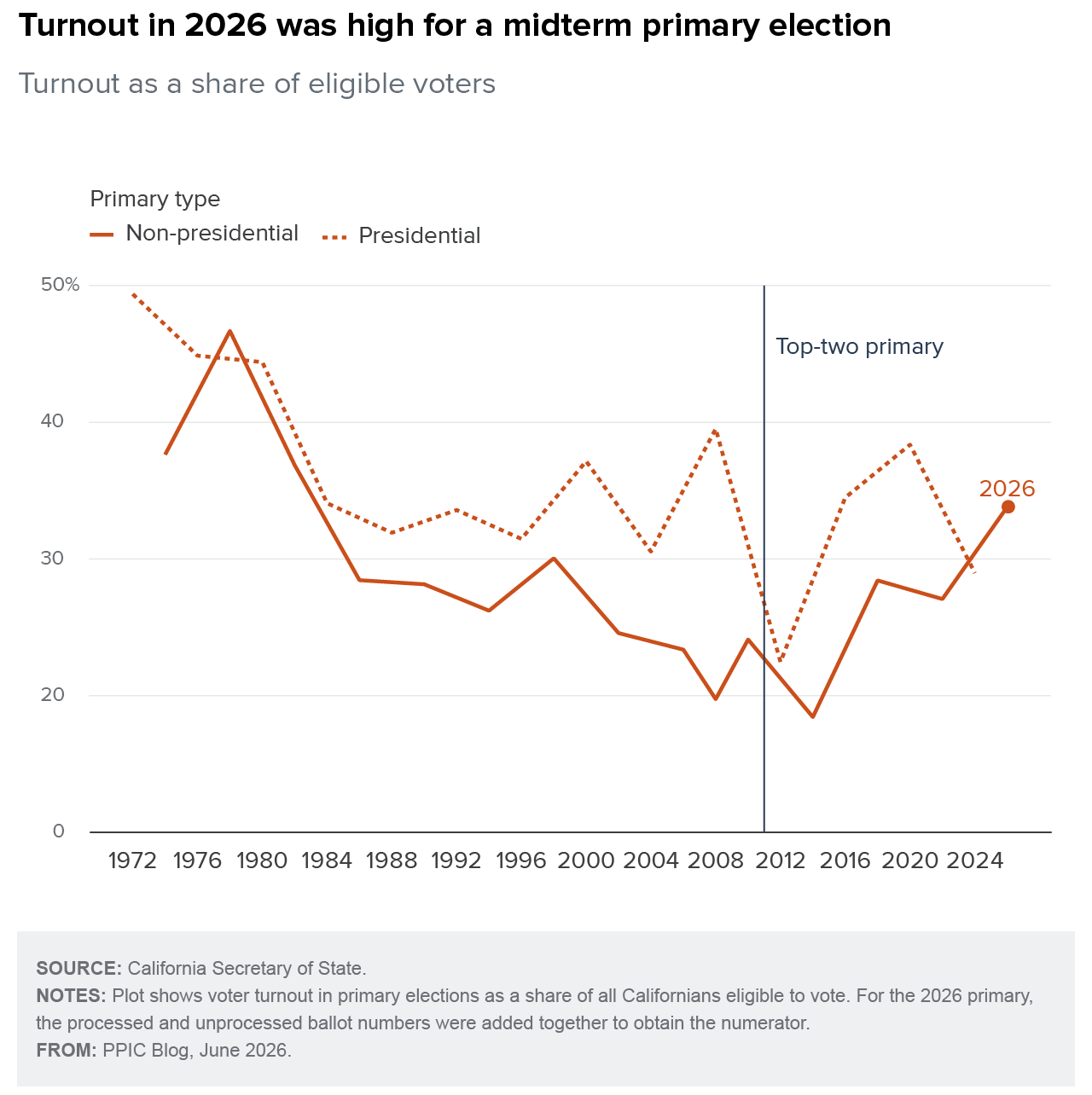
Primary turnout, one of the key selling points of the top two, has stayed flat in presidential primaries and risen slightly in non-presidential primaries (though only starting in the second election under the new system). The presidential contest is not governed by the top two and tends to drive turnout dynamics.
Before the primary, most likely voters were closely following the news about the governor’s race (71%) and expressed more enthusiasm (61%) than usual about voting in this year’s House elections. Republicans were closely following the governor’s race while Democrats were enthusiastic about voting in the House elections. This interest translated to higher turnout. Turnout as a share of the population eligible to vote was higher this cycle (34%) than in any midterm primary since 1982.
Of course, the novelty of the top two has been to offer the possibility of two candidates of the same party as options for the November election. This option has been rare for statewide offices, apart from two Democrats in the races for 2016 US Senate (Harris, Sanchez), 2018 US Senate (Feinstein, DeLeon), and 2018 Lieutenant Governor (Kounalakis, Hernandez). But it has happened in about one of every six state legislative or congressional races since the top two was implemented. The scenario has been far more common on the Democratic side but has shown no clear trends over time.
Did the pattern change in the 2026 primary? The Prop 50 redistricting certainly encouraged more candidates. Though the same number of incumbents ran for reelection as in 2022 or 2024, House incumbents faced more competition. An astonishing two-thirds of congressional incumbents faced a challenger from within their own party, compared to 25% of state senate incumbents and 15% of assembly incumbents.
Despite enthusiasm among Democratic voters, the number of votes cast for Democratic candidates for state senate and assembly is about what it was in 2024, as is the number of districts Democrats “won.” But for the US House, steady Democratic support translated through the new gerrymander to roughly 10 more seats than in 2024. Caution is merited, since support in the primary does not always translate to the fall election. Nonetheless, the Prop 50 redistricting plan is working as expected so far.
The results from statewide contests in the June primary were consistent with past trends; that is, fall races for governor, lieutenant governor, attorney general, secretary of state, treasurer, and controller will include candidates from two parties. However, two Democrats (Allen and Kim) will run for insurance commissioner this fall, for a position with growing policy importance in the face of wildfires and insurance company threats to leave the state.
Looking to November, statewide races are likely to favor the Democrats while House races will be closely watched to see if they help Democrats win back control of Congress. Turnout will be the political wildcard and may be influenced by local elections such as the Los Angeles mayor’s race and citizens’ initiatives such as the billionaires tax. PPIC will continue to monitor the election as events develop.
Topics
2026 Election billionaires' tax Citizen Redistricting Commission elections Political Landscape Proposition 50 redistricting Statewide Survey top-two primary US House of Representatives voter turnout votersLearn More
PPIC Statewide Survey: Californians and Their Government
California Voters and the Top-Two Primary
California’s Election Reforms at the Dawn of a New Decade
