
Rising gas prices hit all California drivers, but they land especially hard on workers who have the farthest to go. Super-commuters—those who drive at least an hour each way to work—face fuel costs that are simply part of the deal when you live far from your job. When prices at the pump surge, as they have sharply in recent months, these workers absorb the blow with few options to reduce their exposure. A recent PPIC analysis found that rising gas prices are straining household budgets across the state, particularly for lower- and middle-income families. Super-commuters are among the most vulnerable—and California has more than its share.
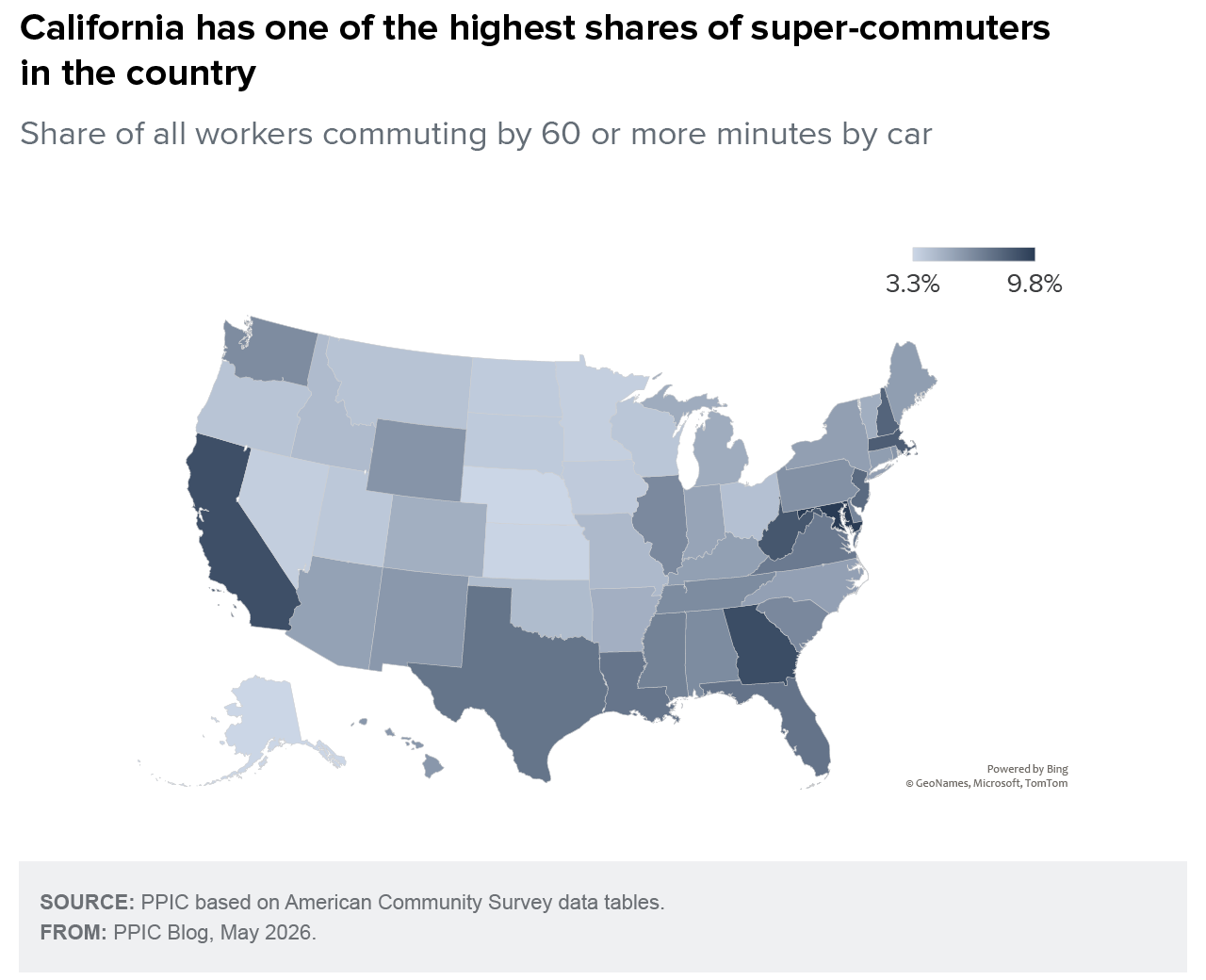
About one in eleven California workers—8.9%—spends at least an hour driving to work, ranking the state third in the nation. Only Maryland (9.8%) and Georgia (9.0%) have higher rates. At the other end of the spectrum sits Nebraska, where just 3.3% of workers face such long commutes. Geography and economics help to explain the contrast: in a densely settled, job-rich state like California, housing in the urban core can be expensive and hard to find, leading some workers to live far from employment centers.
Long commutes are not evenly distributed across California. They are concentrated in exurbs—communities at the outer edge of metropolitan areas, beyond the suburbs, where land is cheaper and housing more attainable. Among California cities with at least 10,000 workers, the highest shares of super-commuters are found in places like Los Banos (48%), Adelanto (36%), Mountain House (35%), Lathrop (31%), and Tracy (31%), based on 2020–2024 American Community Survey data.
These communities share a common profile: they sit adjacent, but not close, to large employment centers in the Bay Area and coastal Southern California. Housing is more affordable in these commuter cites, and homeownership rates are high. Many families have made a deliberate tradeoff—accepting a long commute in exchange for owning a home, something that would be out of reach closer to where they work. Homeownership rates among super-commuters are substantially higher than among other workers (65% vs. 55%).
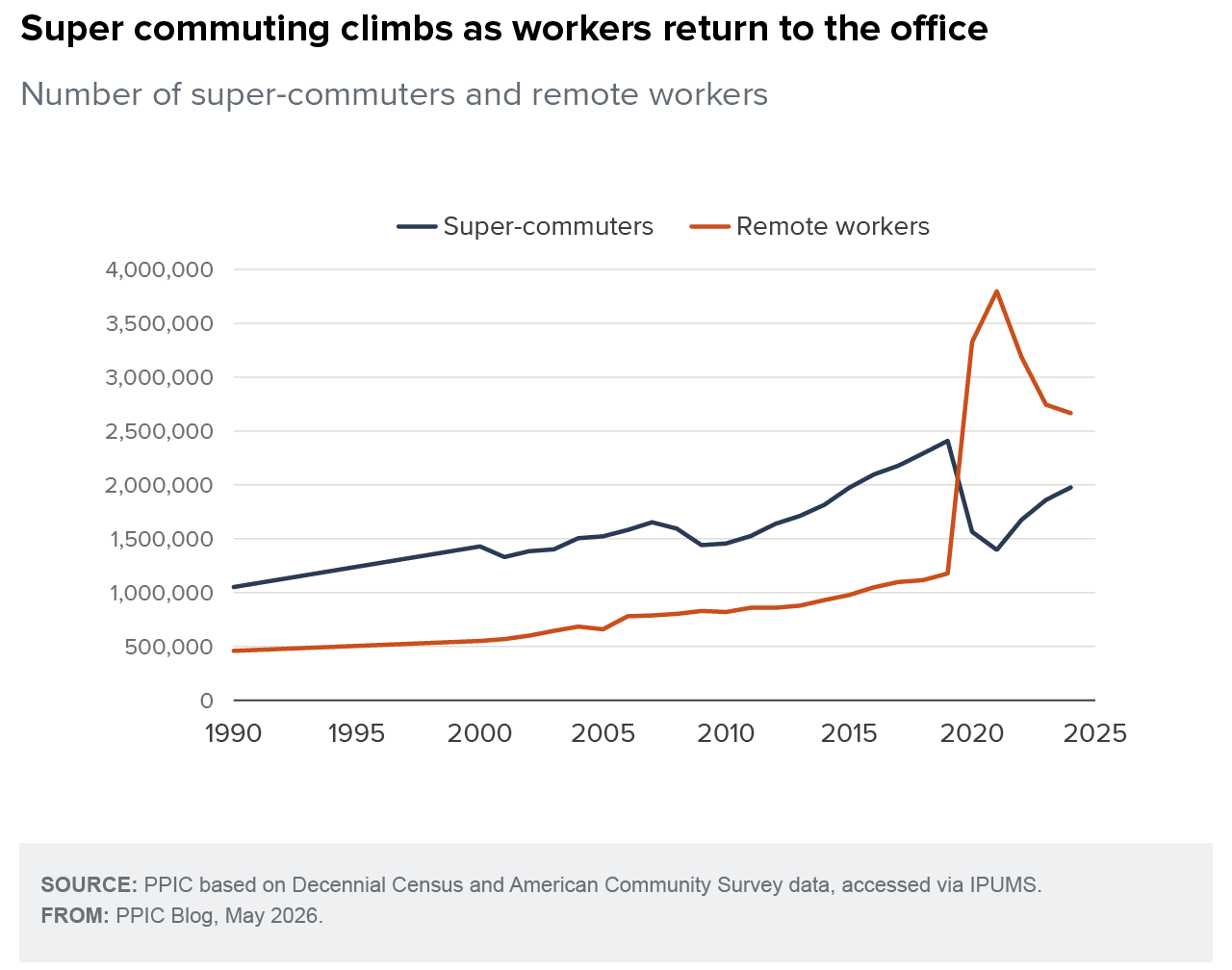
That tradeoff has become more common over time. The number and share of super-commuters in California grew significantly between 2010 and 2019, a period of rapid job growth concentrated in coastal metros where housing costs rose sharply. The pandemic brought a dramatic reversal, as remote work eliminated commutes for millions of workers almost overnight. But that reprieve has been fading. As more employers require workers to return in person, super-commuting has been climbing back toward pre-pandemic levels—and those workers are now confronting gas prices substantially higher than what they faced in the recent past.
Who are these workers? Compared to other workers, super-commuters in California tend to be men (65% vs. 53%), in their thirties or forties (51% vs. 45%), with middle-range incomes (median wages of $68,000 vs. $50,000). They are disproportionately from households with children (50% vs. 45%). Despite their long drives, they are not, on average, severely housing-stressed—the share of income they spend on housing is not dramatically higher than other workers. In fact, that’s partly the point: the long commute is the housing strategy. By living in more affordable exurbs, they keep housing costs manageable even if transportation costs are high.
Super-commuters are not primarily a transportation problem—they are a housing problem made visible on the freeway. When gas prices spike, these workers have limited ways to respond. Most cannot easily switch to transit; bus and rail services to exurban communities are often sparse and slow. Indeed, transit use is low in the areas where super-commuters live. Many cannot work from home. They can carpool, drive less on weekends, or cut other household spending, but there is no quick escape from the daily drive or its costs.
The longer-term answer is to build more housing near job centers and create more jobs in the exurbs—enough to give workers a realistic option of living closer to where they work. California has made progress on housing production in recent years, but construction has not yet translated into meaningful relief for households priced out of coastal communities. Until it does, the workers of Los Banos and Adelanto will keep driving, and every surge at the pump will remind us of what the housing shortage actually costs.