

California’s next governor will take office at a time when crime rates are declining broadly and the state’s correctional populations are at their lowest levels in at least two decades. But some types of crime remain stubbornly high, and state average spending on each individual in prison continues to increase. Moreover, racial disparities in the criminal justice systems are an ongoing concern. Finally, behavioral health issues, combined with limited institutional capacity, also present a challenge.
The Fundamentals
California has seen notable changes to its criminal justice systems over the last 20 years. Surging crime in 1980s and 1990s had sparked tough-on-crime policies that notably increased the state’s prison population, outpacing capacity in spite of adding more prisons. Poor prison conditions were the result, prompting several lawsuits. The appointment of a three judge panel in 2007—the year the prison population peaked—was followed by a 2009 judicial order to reduce the state’s prison population, which ushered in numerous criminal justice reforms aimed at reducing incarceration.
While the state has succeeded in reducing its prison population and improving conditions, California’s prison system remains under federal court oversight, including federally appointed receivers overseeing both medical and mental health care in state prisons. Additionally, the public’s appetite for reform may be shifting: after increases in some types of crime, the passage of Proposition 36 in 2024 revised earlier reforms—in part by increasing penalties for some drug and property crimes.
Key Issues
Crime has trended downward—mostly. California’s property crime rate in 2025 was the lowest in 40 years. The violent crime rate has been decreasing since 2023 and is now slightly below the pre-pandemic rate. The homicide rate has been declining sharply since 2021—after a surge during the pandemic—reaching a historic low in 2025. But aggravated assaults remain 14% above pre-pandemic levels. Auto theft and theft of car accessories, like catalytic converters, also surged during the pandemic but are now below pre-pandemic levels. Shoplifting decreased by 9% in 2025—the first time since 2020—but is still 36% higher than it was in 2019.
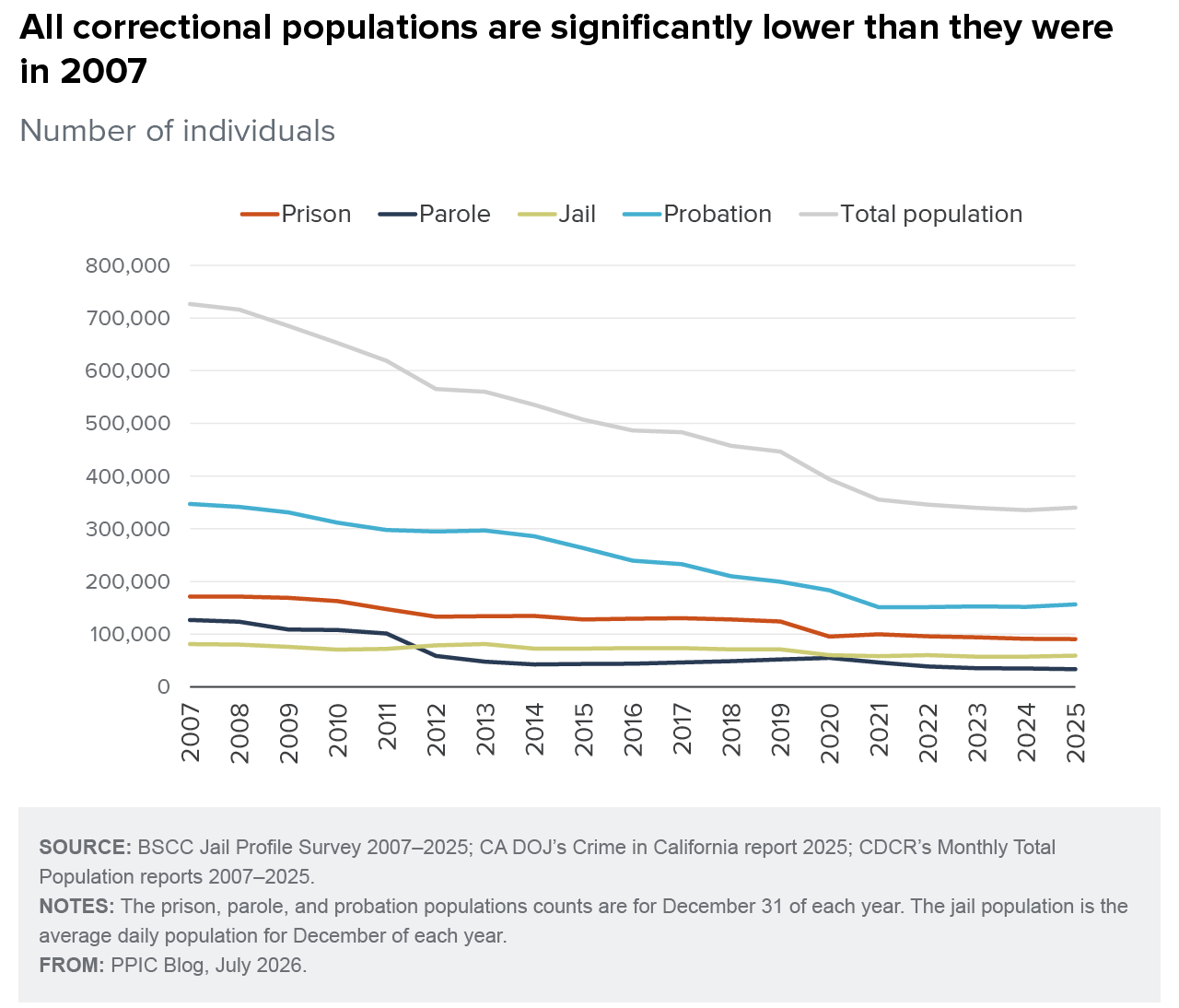
The correctional populational has plummeted. Since reaching a peak in 2007, California’s correctional population—those incarcerated in prison and jails and those under supervision by parole and probation—has declined dramatically. The overall population dropped from 727,000 in 2007 to 340,000 in 2025, a decrease of 53%. The state prison population declined by 81,000 (47%), allowing the state to close three prisons in the last few years, with a fourth closing in late 2026. The number of state parolees has dropped by 93,000 (74%). At the local level, the county jail population dropped by 22,000 (27%); those on county probation declined by more than any other correctional population, by 191,000 (55%).
Significant state support of criminal justice systems continues. In spite of the notable drop in the prison and parole population overall spending on the state prison system (CDCR), about $14.2 billion from the state’s General Fund in the current fiscal year, has only decreased by about 12% when adjusted by inflation.
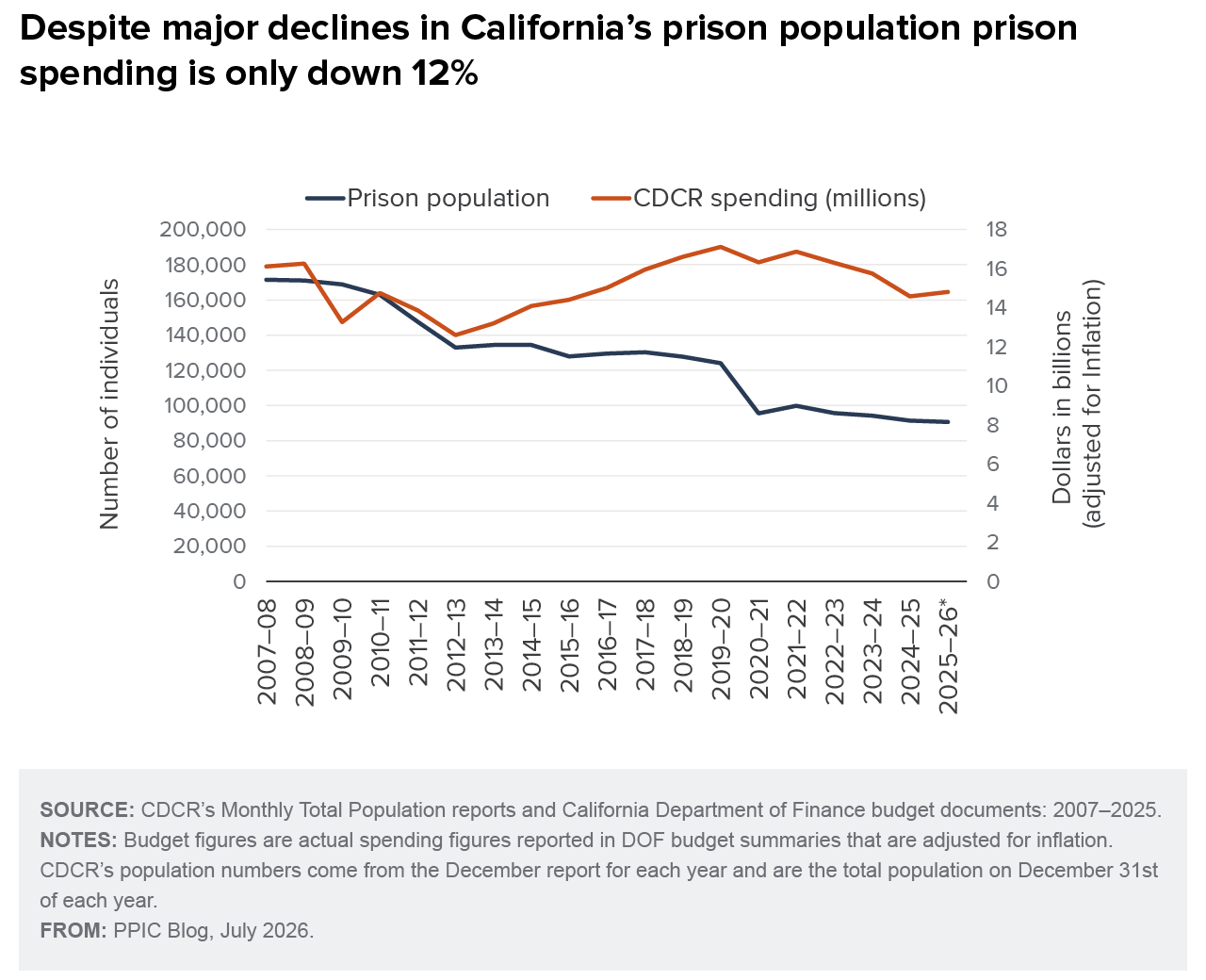
The projected average cost per prisoner for the current fiscal year will be about $138,000, about 76% higher than in 2007. But CDCR staffing is roughly what it was in 2007, according to the Legislative Analyst Office. The overwhelming majority (90%) of CDCR spending is on prison operations, with health care accounting for about 33% and security about 40% of those costs.
Other significant General Fund spending for criminal justice in the current fiscal year includes the judicial branch ($3.5 billion), Department of Justice ($514 million), and Board of State and Community Corrections ($155 million). The state will also spend roughly $3.3 billion on the California Highway Patrol, though most of its funding comes from special funds, not the General Fund. While state spending has increased across the board, spending on criminal justice systems as a share of the General Fund has declined from almost 13% in 2007–08 to 7.4% in the current fiscal year.
Racial disparities have diminished slightly, in some cases. Racial disparities exist throughout the criminal justice system, especially between Black and white Californians. While Black Californians continue to be much more likely than their white peers to be stopped, searched, and have intrusive experiences by law enforcement, the gaps decreased in the post-pandemic years—a period when stops declined by about 1 million, or 26%. Furthermore, while Black Californians represent about 6% of the state’s population, they make up roughly 16% of all arrests, 26% of the probation population, about 25% of the jail population, and 27% of the prison population. Relative to their share of the statewide populations, Latinos are also generally overrepresented in these areas while whites and Asian/Pacific Islanders are underrepresented.
Use of technology is increasing. Emerging technologies and artificial intelligence are being implemented throughout the criminal justice system. New policing technology includes automated license plate readers, gunshot detection devices, and drones. These new tools could bring benefits, allowing agencies to better assign staff to pressing needs—especially important as law enforcement agencies face staffing challenges. However, community concerns must be considered as well, including personal privacy, data protection, and the potential for tools to be deployed in unequal ways.
Looking Ahead
Like the nation, California has seen notable swings in crime rates since the pandemic, currently reaching mostly historic low levels. Taking steps to understand what factors have led to recent improvements will be key to maintaining, and possibly further improving, public safety. This includes determining the role of technology and AI, including their unintended consequences. Efforts to further reduce the elevated rates of aggravated assaults and shoplifting should also be a priority. Conversations around a shortage of judges and adequate representation for criminal defendants are generating important questions around capacity. And with high levels of homelessness and substance use, behavioral health capacity and funding are an important area of concern, particularly in light of mandated treatments for certain repeat drug crimes.
Topics
artificial intelligence auto theft California Department of Corrections and Rehabilitation California Highway Patrol crime Criminal Justice health care homicides jails parole prisons Proposition 36 public safety racial disparities retail theft state budgetLearn More

California’s Prison Population
Understanding Trends in Law Enforcement Staffing

Have Racial Disparities in Law Enforcement Stops Narrowed?

Homicides in California Have Decreased Dramatically
Crime Trends in California