

Key Takeaways
The California Community Colleges system began to overhaul its placement and remediation policies and practices seven years ago, via the implementation of AB 705. How has this reform affected student success in transfer-level math, a key milestone on the path to college completion? And how has it impacted students’ long-term outcomes—specifically, associate degree attainment and transfers to four-year colleges? Our focus is on the years 2022 to 2024—by 2022, access to transfer-level courses was close to universal, and cohorts of students were starting college under AB 705.
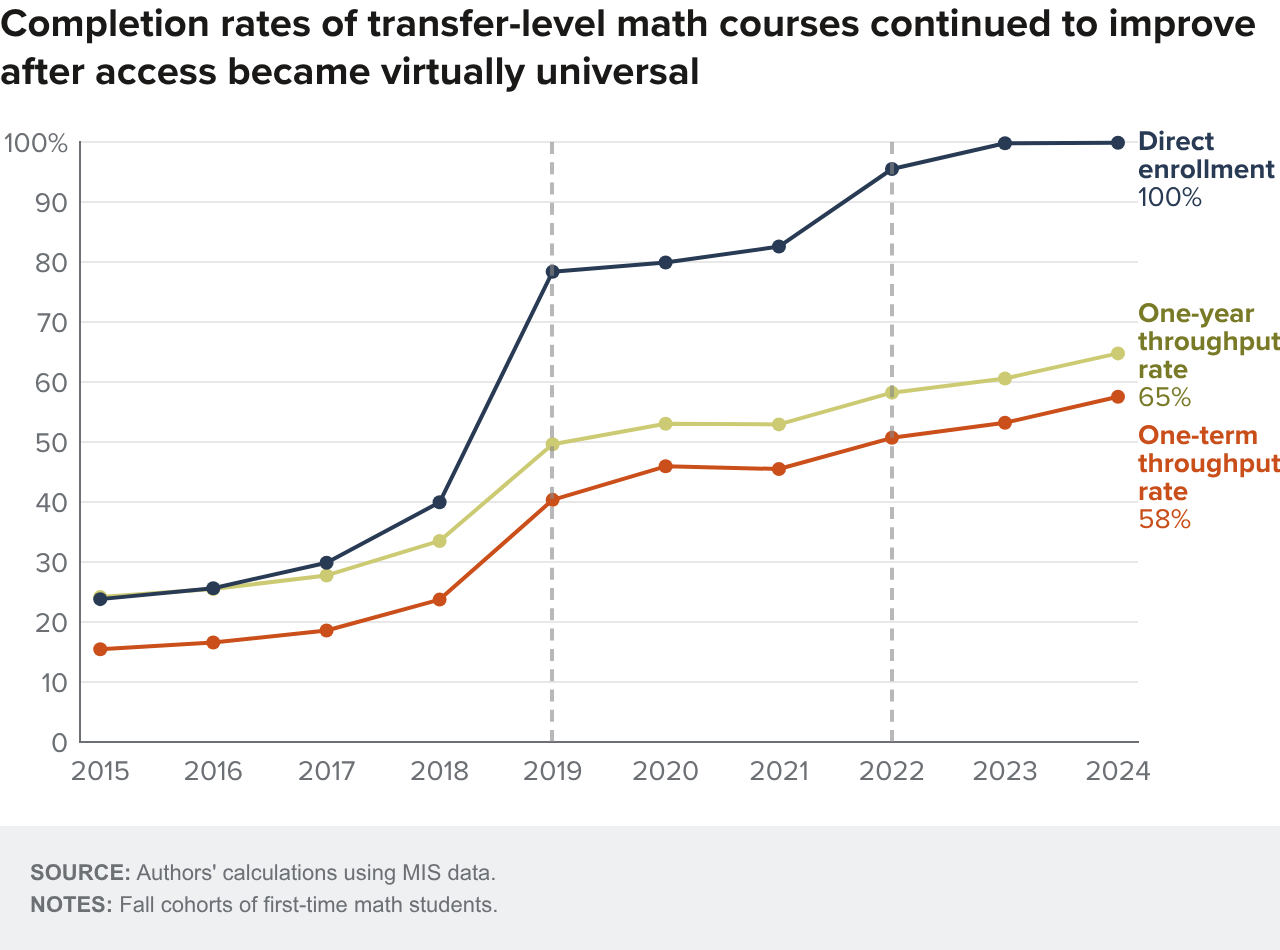
- Completion rates for transfer-level math courses have continued to improve. In fall 2024, 58 percent of first-time math students completed a transfer-level course in their first math attempt; this rate is 7 percentage points higher than two years earlier. Practically all students were enrolling directly in transfer-level math courses, so this increase was not driven by expanded access. →
- Completion gains have varied across demographic groups. Latino and Black students saw much larger increases than their Asian and white peers, but their completion rates continue to lag. Completion rates among first-time math students aged 25 or older grew more sharply than rates among traditional-age students, and increases were slightly higher among women than men. →
- Recent improvements have been driven largely by statistics and liberal arts math (SLAM). In 2024, about six in ten first-time math students enrolled in SLAM courses, and SLAM completion rates increased by 5.4 percentage points, to 62 percent. Both corequisite courses and standalone sections saw improvements. We do not see similar increases among first-time takers of transfer-level math courses leading to Calculus I. →
- Associate degree attainment and transfers to four-year colleges have improved; gains vary across student groups. For example, two-year transfer rates increased more for women than for men (5 vs. 4 percentage points), more for traditional-age students than for older students (4.4 vs. 1.7 percentage points), and more for Asian students than for their Latino and Black peers (6.5 vs 3.4 vs. 2.7 percentage points). →
- Long-term outcomes are better for students who pass transfer-level math in their first attempt. About a fifth (19%) of students who completed transfer-level math in their first attempt transferred within two years, versus only 4 percent of students who did not—and students who do not complete these courses on the first try are more likely to leave the system without transferring or earning a degree. →
The continuing improvement in transfer-level math completion is encouraging—and will likely continue as colleges provide professional development and improve corequisite support. However, our results suggest that more efforts are needed to increase the odds that students who do not succeed on their first try will persist and achieve their academic goals.
Introduction
Developmental education reform in the California Community College system, mandated by Assembly Bills 705 and 1705, has dramatically transformed the community college landscape by expanding access to transfer-level math and English courses. In 2017—the year AB 705 was signed into law—only 30 percent of first-time math students were able to start in transfer-level math courses; today, access to these courses is practically universal. The racial/ethnic equity implications of AB 705 and AB 1705 implementation should not be overlooked: Latino and Black students—who were overrepresented among the population placed in below-transfer-level courses—now have equal access to key transfer-level courses (Figure 1).

This report builds on years of PPIC research on the impact of developmental education reform (Cuellar Mejia, Rodriguez, and Johnson 2020; Cuellar Mejia et al. 2021; Cuellar Mejia et al. 2022; Cuellar Mejia et al. 2023; Cuellar Mejia, Alesi Perez, and Trinidad 2024). We begin by examining how completion rates of transfer-level math courses, overall and for subpopulations, have changed since the implementation of AB 705 and AB 1705. We focus on math because of the strong correlation between transfer-level math completion and long-term success (Cohen and Kelly 2019; Cooper et al. 2022).
Next, we examine how degree attainment, transfers to four-year institutions, and persistence have changed in the years after the implementation of AB 705. Successful completion of introductory transfer-level courses is an important milestone, but the ultimate test of the impact of AB 705 implementation is whether it has helped more students to achieve their long-term academic goals. We conclude by offering some thoughts on what colleges should prioritize in light of our research findings.
Completion Rates of Transfer-Level Math Courses Continue to Improve
Early increases in the share of first-time math students successfully completing transfer-level courses in one term—or the one-term throughput rate—were mostly driven by expanded access to these courses. For example, the first term of systemwide AB 705 implementation saw a 38 percentage-point annual increase in the share of students enrolling directly in transfer-level math courses (from 40% to 78%), and a 17 percentage-point annual increase in the one-term throughput rate, which rose to 40 percent. The one-term completion rate increased another 6 percentage points in fall 2020. Pandemic-era policy shifts, including flexible grading and excused withdrawals, together with expanded and enhanced online student supports—such as tutoring, counseling, and mental health services—supported student success and accounted for the rise in success rates in fall 2020 (Cuellar Mejia et al. 2021). In fall 2022, completion rates increased again, 5 percentage points, mostly as a result of a 13 percentage-point annual increase in direct enrollment in transfer-level math courses.
Between fall 2022 and fall 2024, the one-term completion rate increased 7 percentage points, reaching 58 percent in fall 2024. Nearly all students started in transfer-level courses during this period, so increases in completion rates were not attributable to expanded access. When we account for student demographics and academic backgrounds, we still see a difference in one-term completion rates, albeit smaller. This suggests that while shifts in the student population explain part of the 7 percentage-point increase (Technical Appendix Figure B1), changes within the classroom also played a role. This is a noteworthy result, especially compared to the much smaller increase of completion rates for transfer-level English courses after access became universal (see Technical Appendix Figure B2).
In Figure 2, we can see how the upward trajectory in completion rates relates to the trajectory observed in direct enrollment in transfer-level courses. For reference, we added a third line for the one-year throughput rate, which is the outcome that AB 705 specifically requires colleges to maximize.
Gains in Successful Completion Have Varied across Demographic Groups and across Colleges
In this section, we highlight the student groups who saw the largest improvements in completion of transfer-level math courses, especially since 2022, and discuss how gaps between groups have evolved as a consequence of these changes.
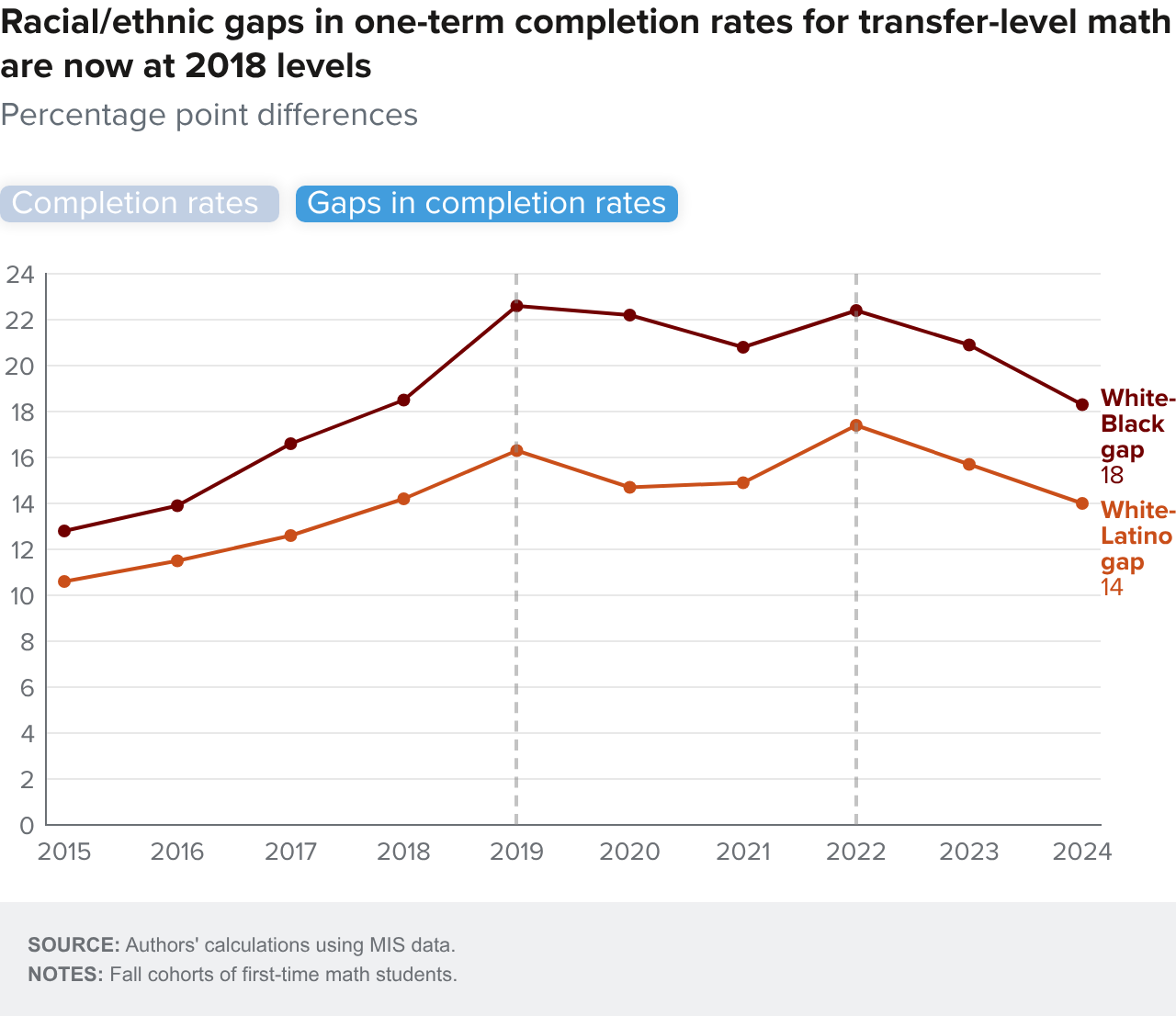
Racial/Ethnic gaps have narrowed. Between fall 2022 and fall 2024, increases in completion rates were much larger among Latino and Black students than among their Asian and white peers (see Technical Appendix Table B1). As a result, the difference in one-term throughput rates between white and Latino students—which peaked at 17 percentage points in fall 2022—was down to 14 percentage points in fall 2024. Similarly, the gap in one-term throughput rates between white and Black students went from 22 to 18 percentage points. In both cases, the gaps returned to the levels observed before AB 705 implementation (Figure 3). It is worth noting that between fall 2019 and fall 2021, differences in throughput rates were partially driven by the continued overrepresentation of Latino and Black students in below-transfer-level courses (see Technical Appendix Table B2).

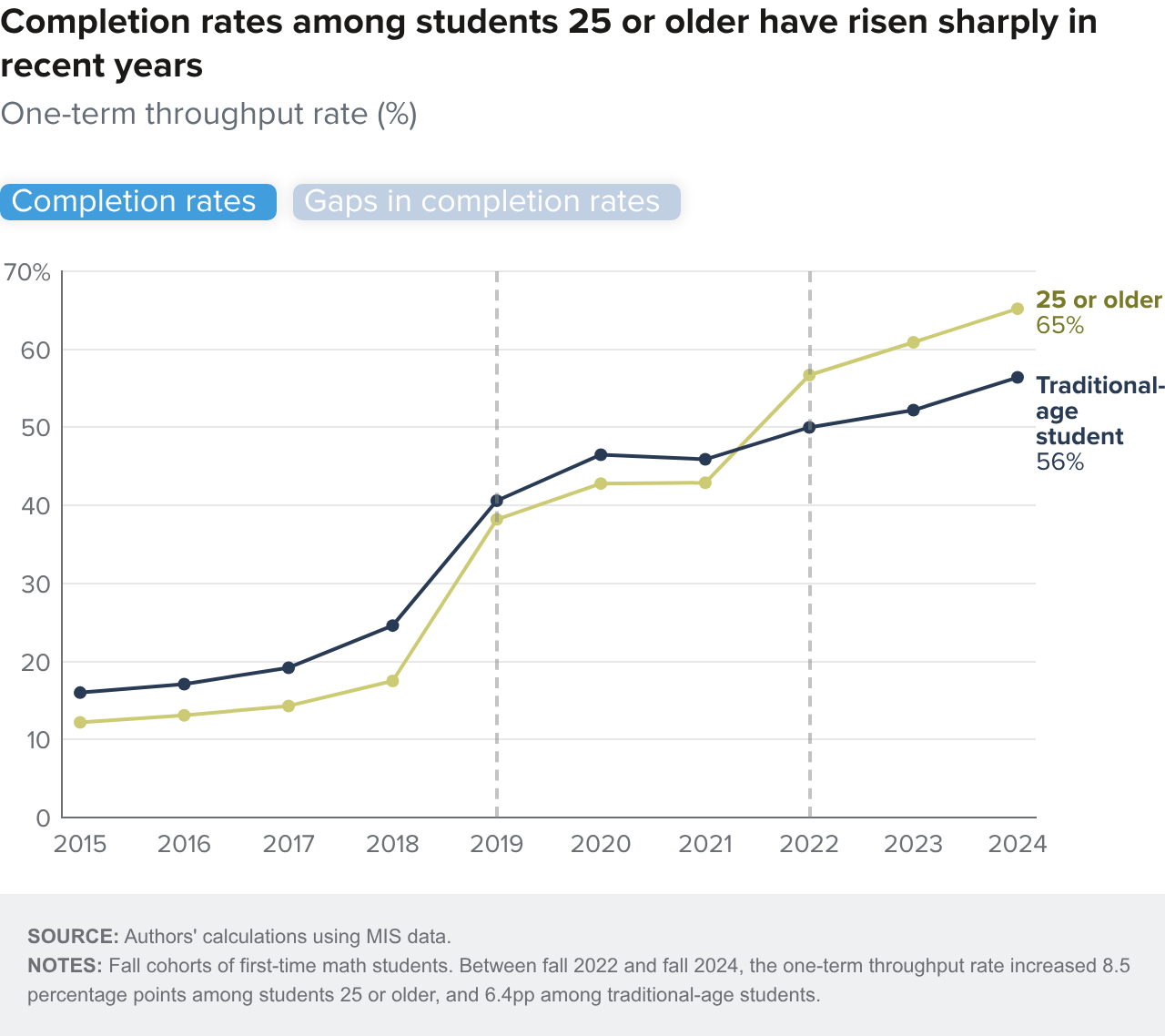
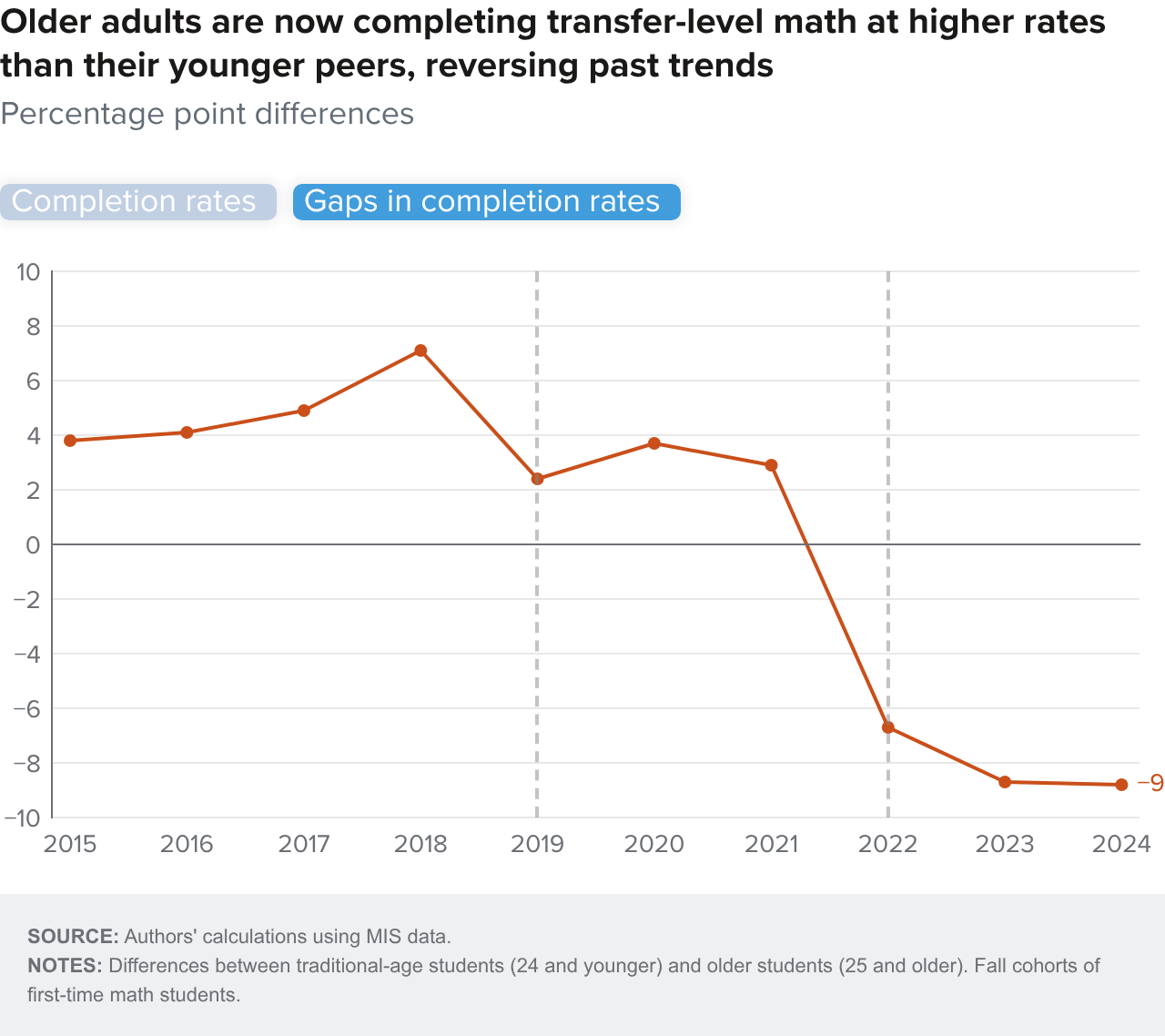
Gains have been greater for older students. From fall 2022 to fall 2024, completion rates among students aged 25 or older grew faster than those of traditional-age (24 or younger) first-time math takers (8.5 versus 6.4 percentage points). As a result, by fall 2024, older adults were 9 percentage points more likely to complete transfer-level math in one term than their younger peers (Figure 4). While colleges were still placing students in below-transfer-level courses, students 25 or older were overrepresented: on average, they represented 13 percent of all first-time math students and 24 percent of students whose first-math course was below transfer level between 2019 and 2021. Consequently, even though older students who were able to start directly in a transfer-level course had higher success rates, one-term throughput rates of students 25 or older were consistently lower than the one-term throughput rates of traditional-age students.
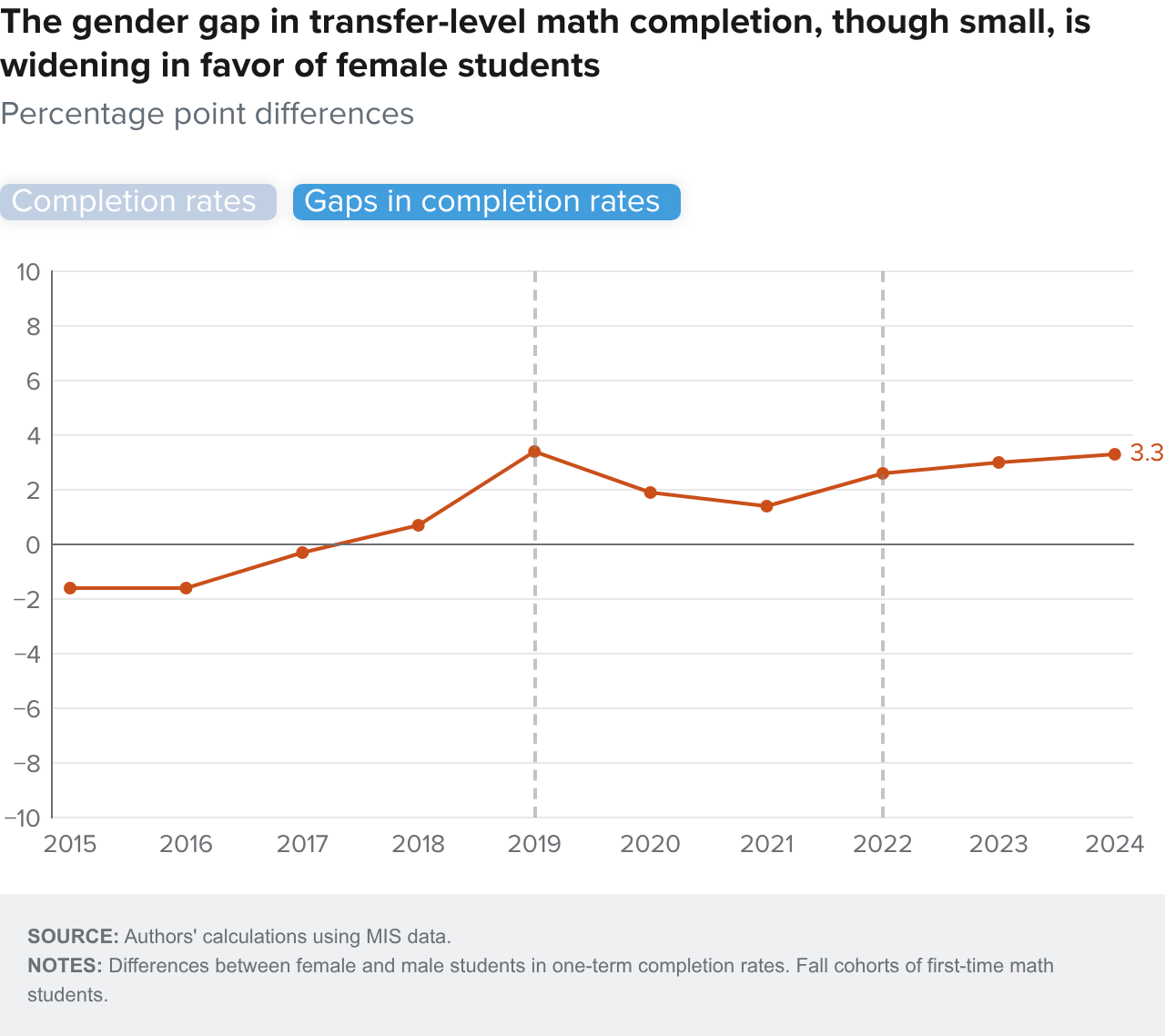
Gender gaps are partially attributable to differing pathways. Between fall 2022 and fall 2024, the one-term throughput rate among female students grew slightly more than the rate for male students. During this period, the female/male gap in the one-term throughput averaged 3 percentage points (Figure 5). This gap can be partially explained by the fact that men are more likely to start in transfer-level math courses in the BSTEM pathway and, on average, successful completion rates are lower for these courses than for SLAM courses. Specifically, 47 percent of male first-time math students started in BSTEM courses in fall 2024, compared to only 28 percent of female students (see Technical Appendix Figure B3); 51 percent of all first-time math students who started in BSTEM courses were successful in their first attempts, compared to 62 percent of those who started in SLAM courses.
Men were also prevalent among those starting in BSTEM courses before AB 705 implementation. Because male students were about 4 percentage points more likely to enroll directly in transfer-level courses than female students, their throughput rates were higher, resulting in a small and negative gap before the policy was implemented.

One-term completion rates have grown unevenly across colleges. About a quarter of the 115 colleges in the system (28 colleges) saw increases that were 13 percentage points or more (one standard deviation) above the systemwide increase. Most of these colleges were in the 25th percentile in terms of completion rates in fall 2022, meaning they had a lot of room for improvement. However, some colleges with relatively low completion rates in 2022 did not see big changes between 2022 and 2024. Indeed, there were still 16 colleges in the system with one-term completion rates of 50 percent or less in fall 2024. (See Technical Appendix Table B3 for completion rates by college.)
Success Rates in SLAM Courses Drove Overall Increases in 2024
After declining at the outset of AB 705 implementation—as the pool of first-time math students bypassing remediation increased considerably in size and heterogeneity—success rates in transfer-level math began to recover in fall 2020. Success rates held steady for the next couple of years and then increased by 4 percentage points between fall 2023 and fall 2024.
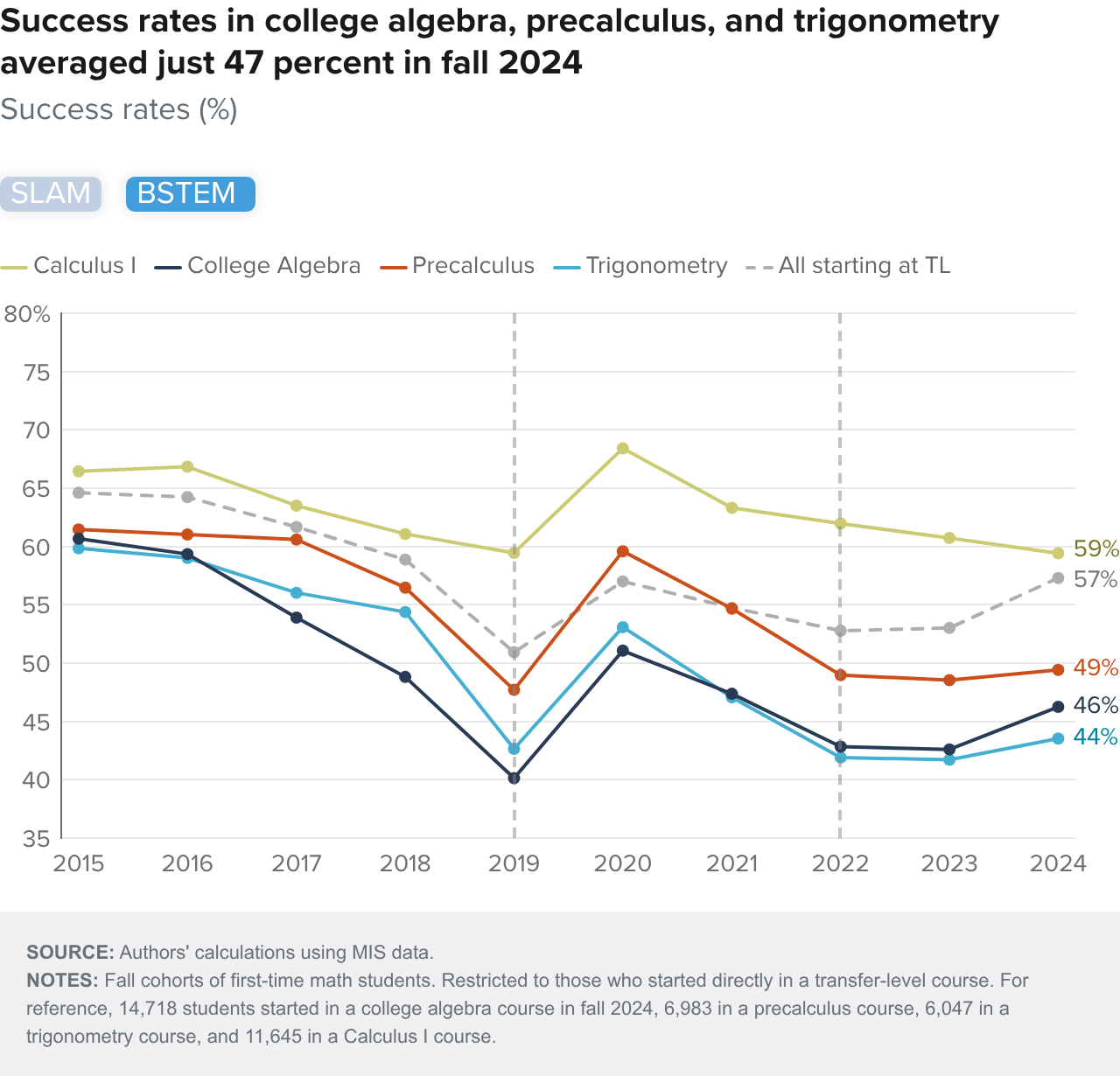
Most of this increase was driven by improvements in completion among first-time math takers in SLAM courses, who represented 61 percent of first-time math students who enrolled directly in a transfer-level course in fall 2024. Success rates in SLAM courses increased by 5.4 percentage points, to 62 percent (Figure 6). We do not see similar increases among those enrolling in college algebra, precalculus, and trigonometry—transfer-level prerequisites to Calculus I, which is the gateway math course for many BSTEM majors. It is worth noting that success rates in these courses (which averaged 47% in fall 2024) lag significantly behind the rates for SLAM courses.
The larger increase in success rates in SLAM courses compared to BSTEM courses could be related to the fact that most colleges implemented changes related to SLAM courses before they made changes to BSTEM courses, giving them more time to fine-tune their reforms and identify effective practices.

Success Rates Have Grown in Both Corequisites and Standalone Sections
The corequisite model is a key component of the effort to increase student success in transfer-level coursework under AB 705. In corequisite remediation, students enroll directly into transfer-level courses and receive academic support alongside their regular classes. In fall 2024, about 26,400 first-time math students, or 21 percent, enrolled in corequisites (Figure 7). Between fall 2021 and fall 2024, corequisite enrollment increased 43 percent. This is consistent with the fact that starting in fall 2022, colleges started to place practically all students directly into transfer-level math courses.
Success rates in corequisite courses dipped below 50 percent in fall 2022 and fall 2023 but recovered to 51 percent in fall 2024 (Figure 7, second tab). These rates may seem low; however, we can’t forget that most students in corequisites would have been placed in remedial courses, which would have lowered their chances of successfully completing a transfer-level course significantly. For example, only 18 percent of first-time math takers in fall 2018 who started in a below-transfer-level course had successfully completed a transfer-level course as of fall 2019 (see Technical Appendix Figure B5).
Consistent with our overall success rate findings, we see larger improvements in corequisite courses in the SLAM pathway than in the BSTEM pathway. Indeed, between fall 2023 and fall 2024, success rates in SLAM corequisite courses grew 3.9 percentage points, while success rates in BSTEM corequisites increased 2.1 percentage points. However, it is worth noting that success rates in BSTEM corequisites grew more than success rates in BSTEM standalone sections (see Technical Appendix Figure B6).


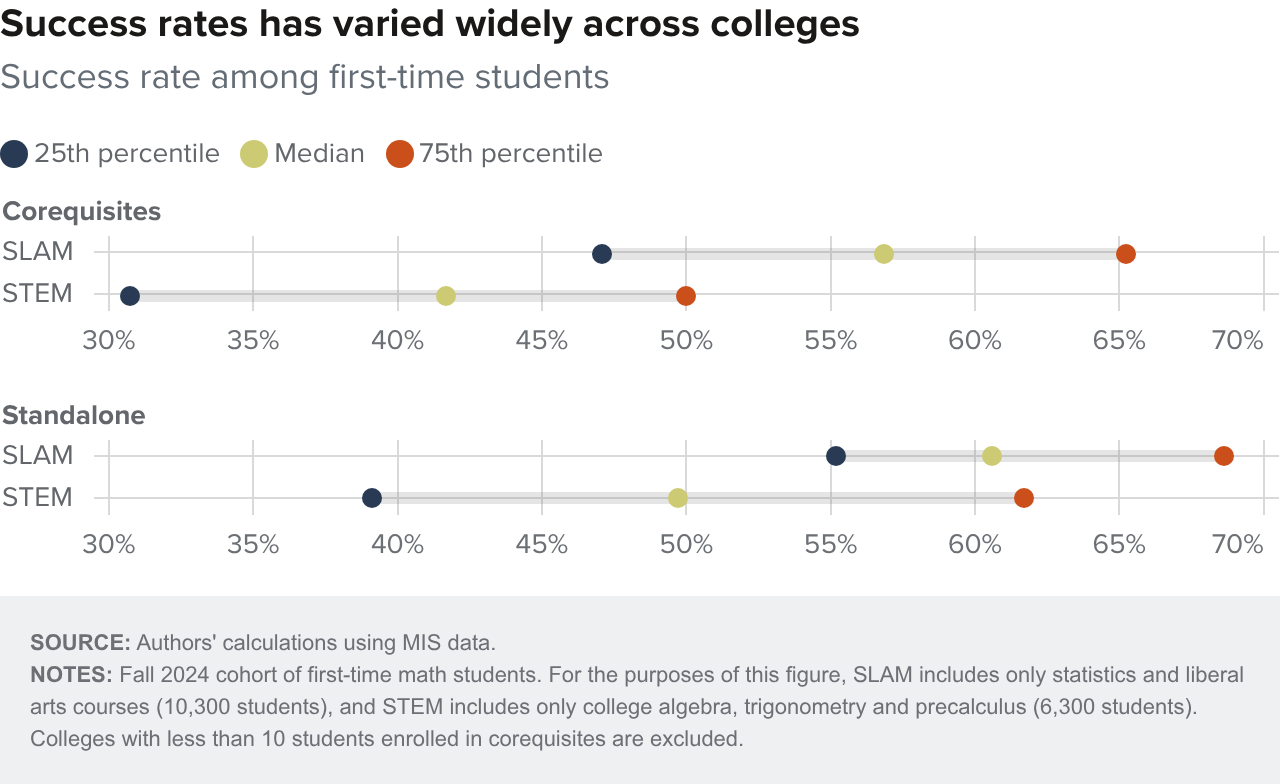
In both SLAM and BSTEM courses, completion rates among corequisite students vary widely across colleges (Figure 8). In a quarter of the colleges that offered corequisites for statistics and/or liberal arts math, less than 47 percent of corequisite students successfully completed the transfer-level course in one term. At the other extreme, in a quarter of colleges with corequisites, more than 65 percent of students who started in a corequisite model successfully completed the transfer-level course in one term. This means there was an 18 percentage-point gap in completion rates between the colleges with the lowest and highest throughput rates (interquartile range). It is worth noting that when we look at the performance of students in standalone sections, we see a smaller, but still substantial, interquartile range (13 percentage points). Interestingly, in the case of STEM courses, the variation is higher in the standalone sections.
Some colleges are experiencing great success with corequisite support courses. In fall 2024, 20 colleges saw corequisite completion rates in SLAM courses exceed 69 percent (the 75th percentile for standalone sections), whereas in STEM, only 6 colleges met that bar. Disparities between colleges highlight both the need for improvement and the untapped potential of corequisite models. More research is needed to understand why math corequisites may be seeing success and growth in some contexts and not in others.
Community colleges have continued to build on the initial success of AB 705, and state investments could spur further improvement in completion of transfer-level courses. Following the passage of AB 1705, the legislature appropriated $64 million in one-time funding in the 2022 state budget act to establish the California Community College Equitable Placement, Support, and Completion funding allocation. These funds were intended to assist colleges in developing corequisite support models, providing professional development and technical assistance, aligning concurrent student support services, and creating innovative course sequences that reduce possible exit points for students (Lowe 2023). It will be essential to evaluate the extent to which colleges’ investment choices translate into improvements in successful completion of transfer-level math and English courses, racial equity, and the outcomes of corequisite students.
Direct Enrollment in Calculus I Has Increased amid Debate over AB 1705 Rules
Because Calculus I has been at the center of a heated debate in the context of AB 1705 implementation, it warrants a separate discussion. Past research has shown that some students never get to calculus because they fail to complete necessary prerequisite courses like trigonometry or precalculus (Burdman, Baker, and Henderson 2021). AB 1705, signed into law in 2022, set new standards for placement and first math enrollment to ensure that students pursuing calculus-based associate degrees or preparing to transfer and major in STEM begin in transfer-level coursework that best positions them to complete calculus requirements. This legislation calls for colleges to provide evidence that STEM students are benefiting from enrollment in transfer-level prerequisites for Calculus I.
Initial implementation guidance directed colleges to stop requiring or even recommending enrollment in these prerequisites if they could not show that those courses benefit students. This guidance was heavily debated; critics pointed out that because the bar for student success in preparatory courses was set too high, many colleges were effectively forced to eliminate them. Some math educators worried that students without a solid math foundation would struggle if they had to start in calculus and might abandon STEM pathways (Burdman 2024).
As a result, the California Community College Chancellor’s Office loosened STEM math placement rules, allowing students who didn’t pass Algebra II or its equivalent in high school to take two semesters of calculus prerequisites. Students who did pass Algebra II but not trigonometry or precalculus can enroll in a one-semester prerequisite course (typically precalculus).
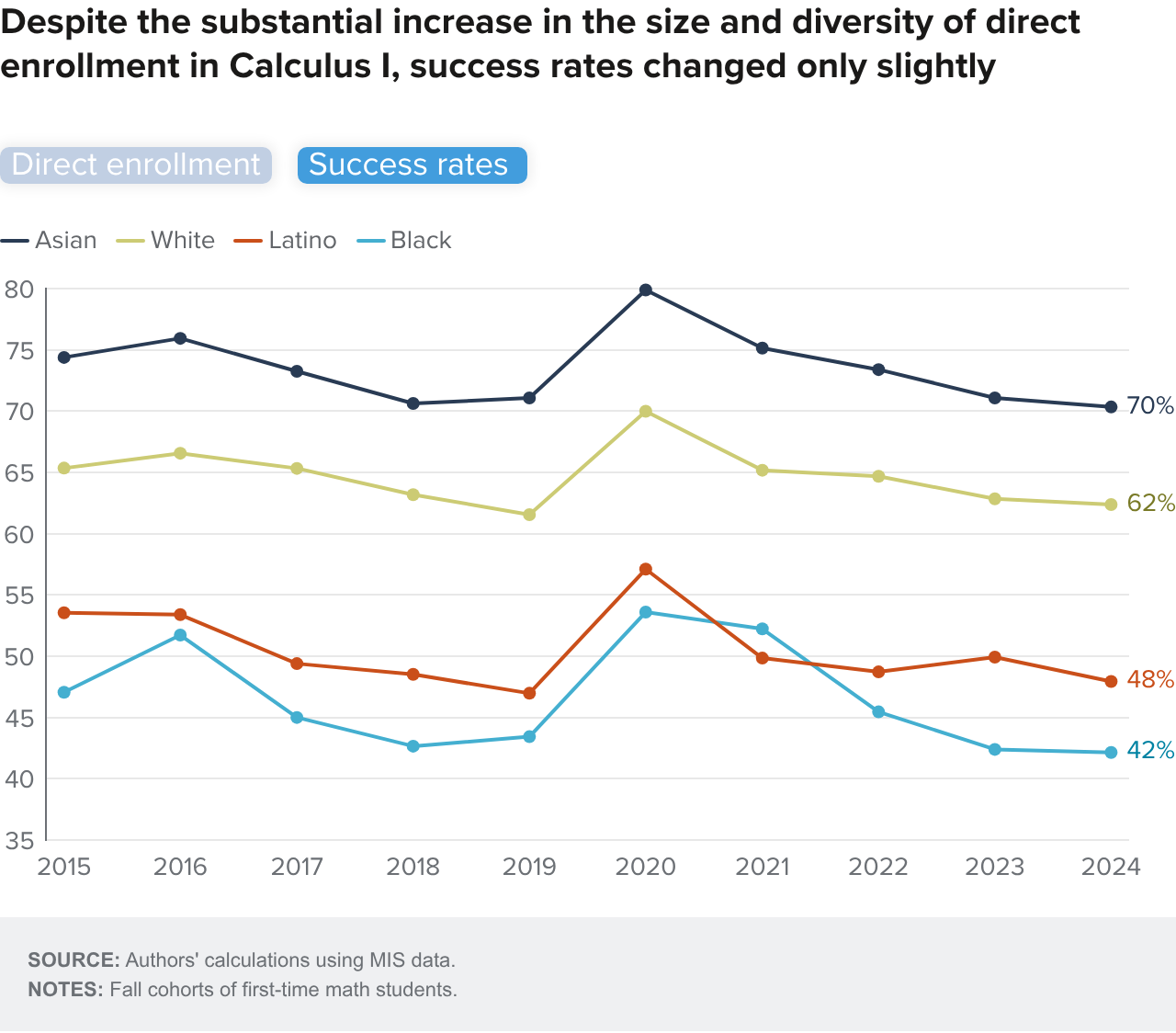
The number of students starting directly in Calculus I has grown substantially (Figure 9). In fall 2024, 11,700 first-time math takers (or 9%) started in Calculus I, 69 percent more than in fall 2017. Enrollment among Latino students increased most sharply (122%). Consequently, Latino representation among students starting directly in Calculus I rose from 27 percent in fall 2017 to 36 percent in fall 2024. Unfortunately, we have not seen similar growth in female representation in Calculus I (see Technical Appendix Figures B7 and B8).
Success rates are higher in Calculus I than in college algebra, precalculus, and trigonometry. In Figure 9 (second tab), we can see that success rates in Calculus I have decreased only slightly despite the increase in the number of first-time math students enrolling directly there. Importantly, the number of first-time math students completing Calculus I in their first attempt increased 58 percent between 2017 and 2024.

In fall 2024, many more colleges started to offer Calculus I corequisites and are seeing good results. Indeed, success rates in both Calculus I corequisites and standalone sections were the same (61%), which is not the case in other subjects (see Technical Appendix Figure B9).
How Have Longer-term Student Outcomes Changed?
In this section, we examine two-, three-, and four-year outcomes for students who started college after the implementation of AB 705, starting with the fall 2019 cohort, and compare them with outcomes among earlier cohorts (2015–2018). We also examine variation in outcomes based on initial transfer-level math success, corequisite support, and student demographics. It is important to note that this is a descriptive analysis; we are not implying causation.
Higher Shares of Students Have Transferred or Earned Associate Degrees
Transfer and associate degree attainment rates are higher among students starting in community college in the years following the implementation of AB 705. This is especially true when we look at two-year outcomes. Between 2019 and 2022, 11 percent of students transferred within two years of initial enrollment, which is 4.5 percentage points higher than the average transfer rate from 2015 to 2018. In numerical terms, 52,500 students in the 2019–2022 fall cohorts transferred to a four-year institution within two years, compared to 39,500 students in the 2015–18 fall cohorts (a 33% increase). In addition, 6 percent of students earned terminal associate degrees, more than double the share observed among pre–AB 705 cohorts (Figure 10).

It is important to note that we are not attributing these results solely to the implementation of AB 705. Both the California Community Colleges and four-year institutions have launched policies, programs, and initiatives to streamline the transfer pathway and boost degree attainment (Cuellar Mejia et al. 2023). At the same time, the pandemic negatively impacted student enrollment, persistence, and success; consequently, any progress we identify in degree and transfer attainment may be a lower-bound estimate of the actual effects of AB 705, AB 1705, and other reforms implemented during this period.
Two-year outcomes for AB 705 cohorts improved unevenly across demographic groups
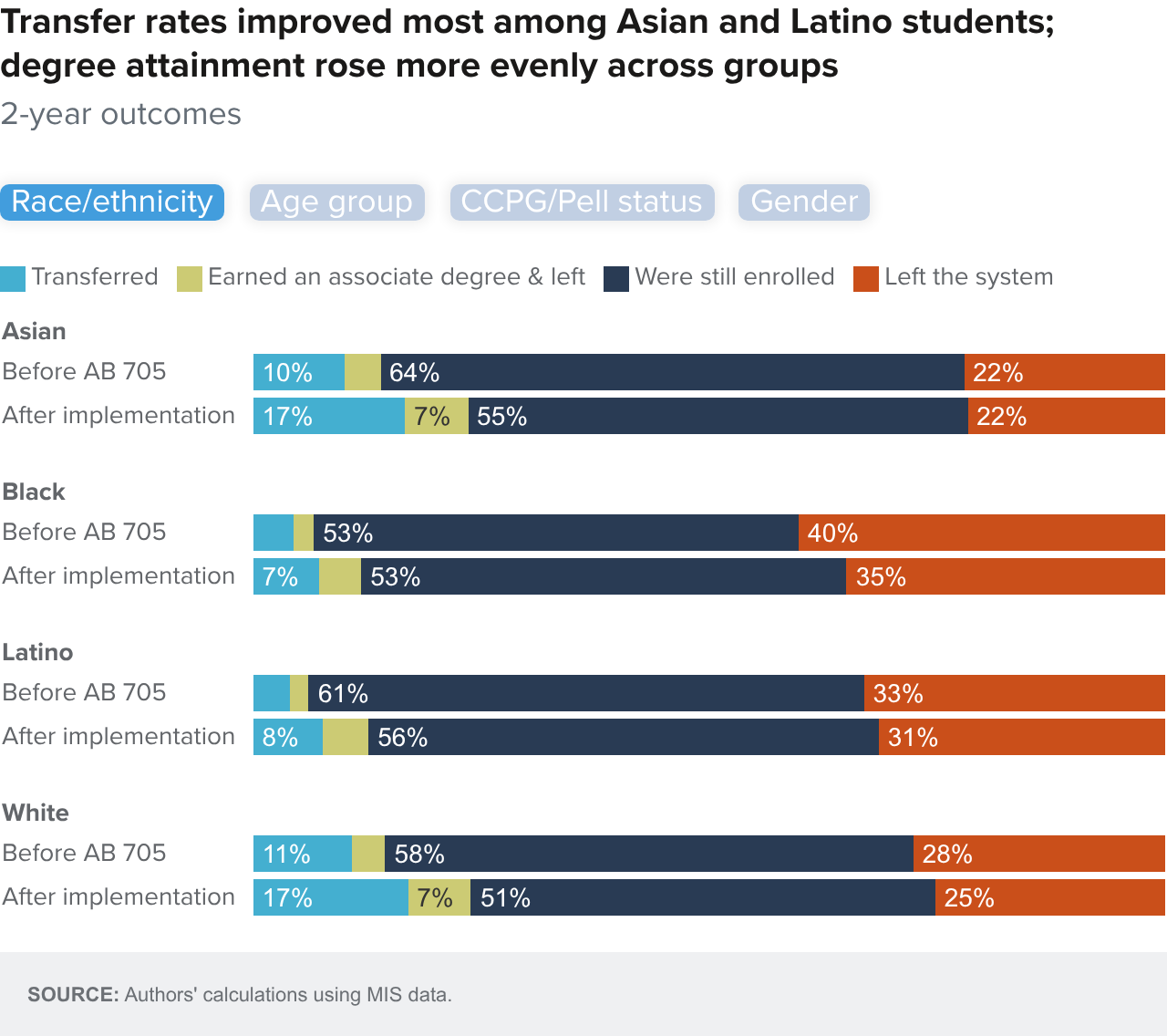
In this section we examine the variation in two-year outcomes across race/ethnicity, age, financial need, and gender. As we can see in Figure 11, increases in transfer and degree attainment rates were felt across the board.
Race/ethnicity: Following the implementation of AB 705, 45 percent more Latino students transferred to a four-year university (5,700 additional students). Despite increasing 3.4 percentage points, their two-year transfer rate (8%) was less than half that of their Asian and white peers (17%). Asian students saw the second-largest increase (by 36%, or 2,800 additional students), which brought their transfer rate from 10 percent to 17 percent. Meanwhile, the number of Latinos earning associate degrees and leaving the system doubled. All other groups saw increases of around 46 percent. In the AB 705 cohort, 5 percent of Latino and Black students earned associate degrees and left, compared to 7 percent of Asian and white students.
Age: Traditional-age students saw significant improvements in two-year transfer rates following the implementation of AB 705; these rates rose from 7.3 percent to 11.6 percent—representing a 34 percent increase in the total number of students who transferred. Two-year transfer rates also rose among older students (2.2% vs. 3.9%). Increases in the share of students earning associate degrees and leaving the system were greater among older students than among traditional-age students.
CCPG/Pell status: The increase in transfer rates was similar for CCPG/Pell recipients and non-recipients (about 4 percentage points). However, growth in the number of students who transferred was 10 percentage points higher among recipients (37% vs. 27%).
Gender: Gains in both transfer rates and associate degree attainment were slightly greater among female students than among their male peers. Female two-year transfer rates rose from 7.2 percent before AB 705 to 12.2 percent after AB 705 was implemented, and degree completion among women grew from 3.2 percent to 6.8 percent; meanwhile, among male students, two-year transfer rates increased from 6.1 percent to 10.1 percent, and the share earning associate degrees and leaving the system rose from 2.3 percent to 4.8 percent. Overall, the volume of female students successfully transferring increased by 37 percent (8,000 additional students), and the number earning associate degrees and leaving the system surged by 71 percent in the post-reform period (7,000 additional students).


Long-term outcomes of students who complete transfer-level math courses in their first attempts have not changed significantly
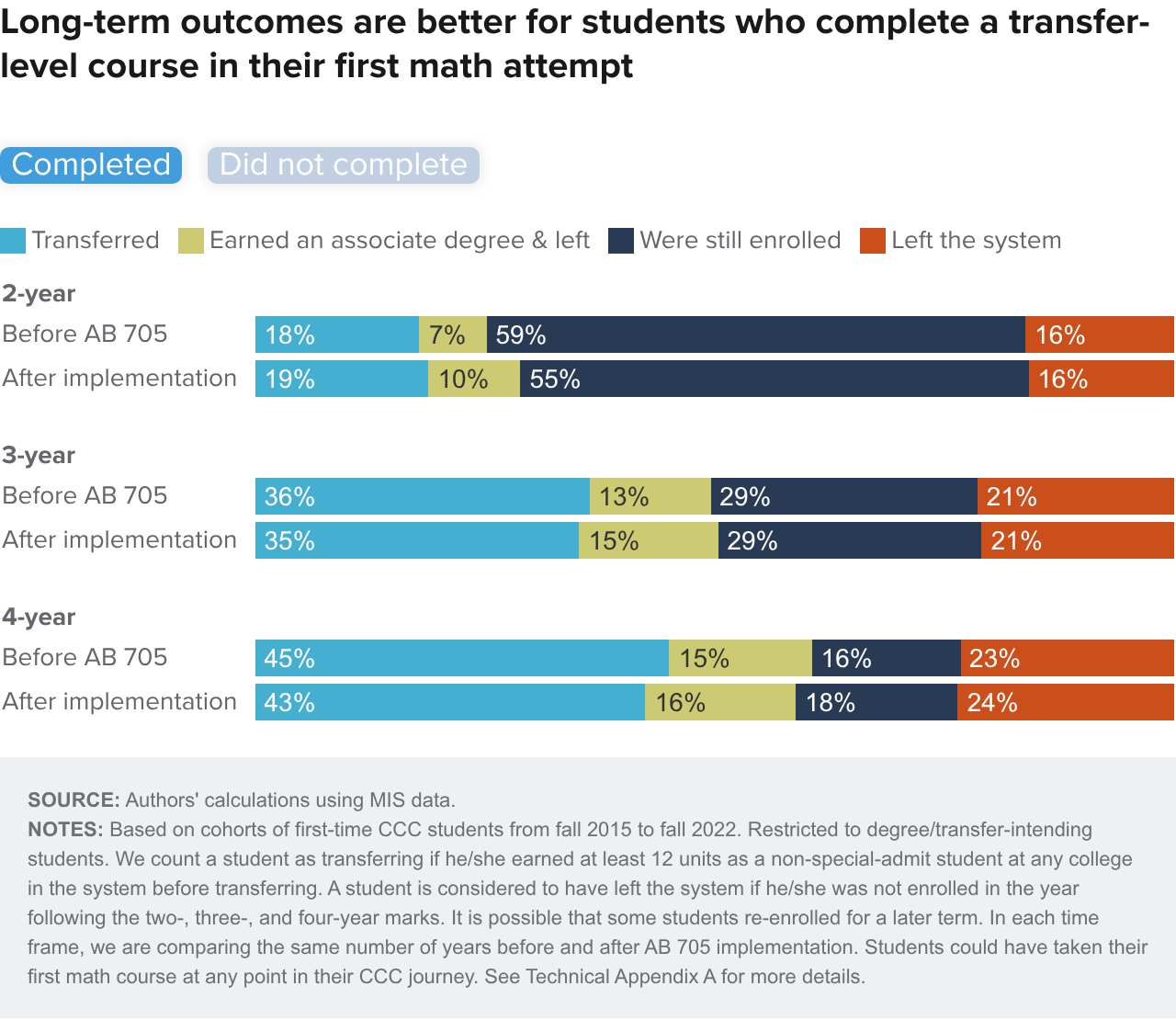
Unsurprisingly, long-term outcomes have been better for students who enrolled directly in and successfully completed transfer-level math in their first attempt. Between 2019 and 2021, 19 percent of students who successfully completed transfer-level math in their first attempt transferred within two years of initial enrollment, compared to only 4 percent of those who did not succeed on the first try or started in below-transfer-level courses. This is also true before AB 705 implementation.
Interestingly, long-term outcomes look very similar for student cohorts before and after AB 705 implementation despite the dramatic increase in the number and diversity of students successfully completing transfer-level math on their first math enrollment (Figure 12). For example, two-year transfer rates increased only a single percentage point, despite a 78 percent surge in the number of students completing transfer-level math—rising from 111,300 (20%) in the pre–AB 705 cohort to 198,200 (48%) in the AB 705 cohort.
These results address concerns that AB 705 would negatively impact long-term student success. Some AB 705 critics have suggested that the more academically heterogeneous set of students starting in transfer-level math courses under AB 705 has prompted instructors to dilute course content (Bezerra-Nader 2019). In their view, many students who gained direct access to and passed these transfer-level courses would therefore lack the tools needed to succeed in the long term. Our findings suggest that AB 705 does not seem to have a negative impact on longer-term outcomes.

Longer-term outcomes improved for students with remedial needs
Next, we investigate how the long-term outcomes of students whose first math course was transfer level with corequisite support compares to those whose first math course was a below-transfer-level course and find that both associate degree attainment and transfer rates are higher (Figure 13). Specifically, 8 percent of students who started in a corequisite math course transferred to a four-year institution within two years of initial enrollment, compared to just 3 percent of students who started in below-transfer-level courses.
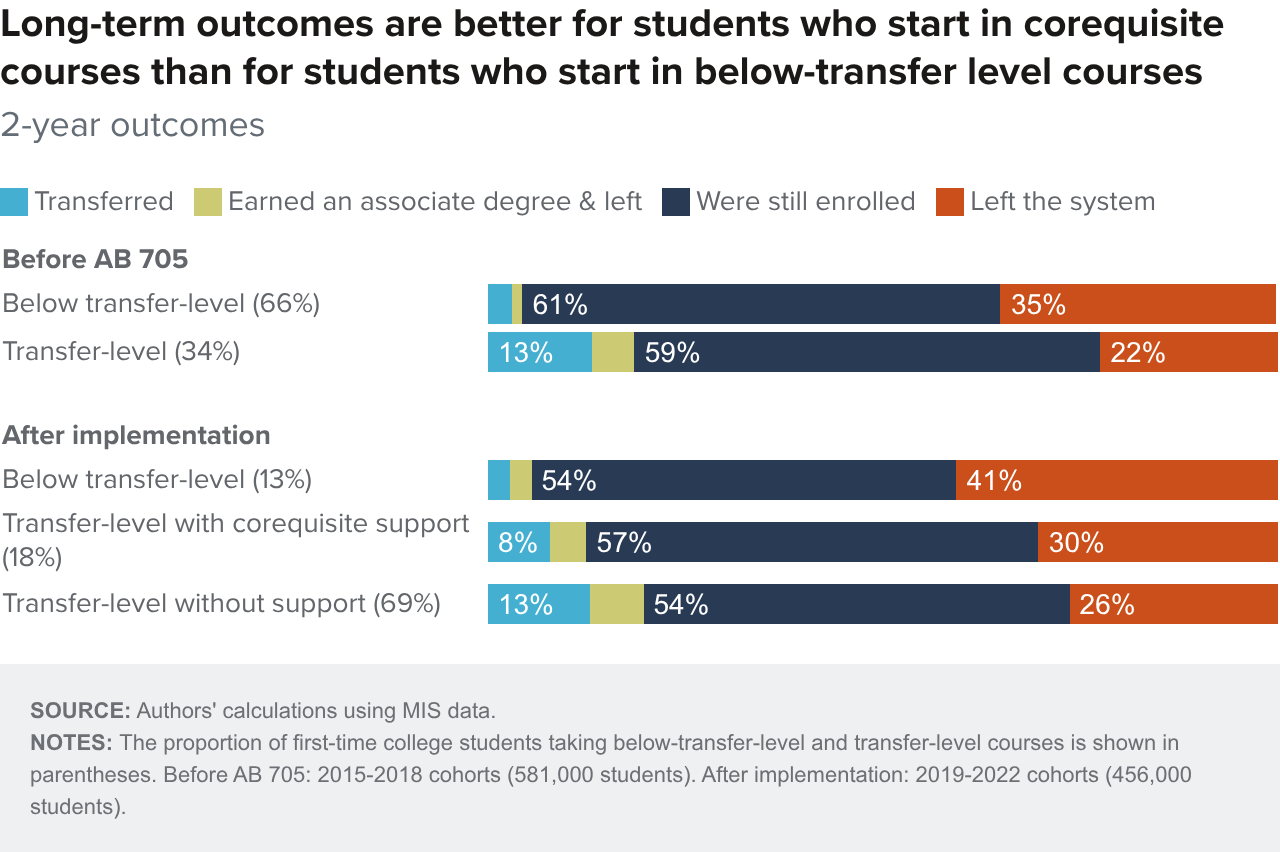
Importantly, students who started in a transfer-level math course without corequisite support were equally likely to transfer to a four-year institution both before and after AB 705 implementation. This is a remarkable result, given the sharp increase in the number of students starting directly in transfer-level courses: while only 34 percent of first-time college students in our pre–AB 705 cohorts enrolled directly in transfer-level math, 69 percent of our AB 705 cohorts did so, with no drop in overall transfer rates.
Regardless of where students in our AB 705 cohorts are starting their math journeys, higher percentages have been leaving the system without a degree or transferring (Figure 13). There are several possible drivers of this trend. First, the COVID pandemic had an impact on persistence. Second, a strong labor market for workers without college degrees that characterized most of our period of analysis increased the immediate opportunity cost of attending college (Lafortune and Bohn 2023). Third, the growing skepticism about the cost and value of a bachelor’s degree may have deterred some students from continuing their studies. Finally, it is possible that AB 705 implementation also played a role: students who were unsuccessful in their first attempts at transfer-level courses may have felt discouraged and decided to leave the system.
A relevant question at this point is whether there are differences between the population of students who left (or stopped out) before and after AB 705 implementation. In terms of demographics, students in the AB 705 cohort who left the system without obtaining degrees or transferring are more likely to be traditional-age and slightly more likely to be male than those in the pre–AB 705 cohort. However, there is not a significant difference in terms of the racial/ethnic profiles of these students or in their academic performance. These results suggest that external forces such as a strong labor market and college affordability concerns played a larger role than AB 705 in increasing the number of students leaving the system without obtaining degrees or transferring. The fact that 28 percent of stop-out students in AB 705 cohorts completed transfer-level math on their first attempt—compared to 10 percent in pre–AB 705 cohorts—also suggests that AB 705 implementation was likely not a negative factor for those students.
Conclusion
The ongoing improvement of one-term throughput rates in transfer-level math is encouraging. Equally encouraging is the fact that higher shares of students have been transferring or earning associate degrees in the years since the implementation of AB 705. Moreover, the long-term outcomes of students who successfully complete transfer-level math courses in their first attempts do not differ dramatically from the outcomes of successful students in pre–AB 705 cohorts—suggesting that introductory transfer-level courses have not been diluted.
However, students who do not successfully complete transfer-level math in their first attempt are significantly more likely to leave the system without transferring or earning a degree. While our research shows that it is unlikely that these students would have been better off in remedial courses (which are associated with very low persistence and transfer rates), more efforts are needed to increase the likelihood that students who fail their first transfer-level course will persist and achieve their academic goals. Following up with these students about re-enrolling and better supporting their subsequent attempts should continue to be a priority. In addition:
- College initiatives that effectively address the academic and non-academic needs of students should be prioritized. Special programs that provide wraparound support, especially those modeled on effective evidence-based programs like the City University of New York’s Accelerated Study in Associate Programs (ASAP), could assist in these efforts.
- Implementing well-designed corequisites should also play an important role. Some colleges are having great success with corequisite models, while other colleges are lagging very far behind.
- The state’s $64 million investment to support the implementation of AB 1705 may lead to additional improvements in student outcomes. Future research should examine how colleges have invested these funds, and how these investments impacted completion rates and racial/ethnic gaps.
Finally, more research is needed regarding Calculus I, which has been controversial not only in the context of AB 1705 but also because it has served more as a gatekeeper than as a gateway to BSTEM majors. Critics argue that while it is essential for engineering and physics, Calculus I is a roadblock to biology, social science, and other majors. We have seen important increases in the number of students enrolling directly in and completing Calculus I. We need to assess whether this trend is linked to increases in the number and diversity of students who earn community college degrees and/or transfer to four-year schools as BSTEM majors.
Topics
Access Completion Equity Higher EducationLearn More

Community College Reforms Have Improved Student Success in Math

Testimony: Remarkable Progress in Student Success Spurred by Reforms at California’s Community Colleges

Community College Math in California’s New Era of Student Access