Table of Contents
Key Findings
This year marks the twin anniversaries of landmark legislation that has shaped the state’s environmental policies: the California Coastal Act of 1976 and the Global Warming Solutions Act of 2006. Today, California’s longstanding commitments to protecting its coastal waters and reducing greenhouse gas emissions are sharply at odds with federal policy shifts that now call for more oil drilling off the coast and reversing course on renewable energy programs. Today, the state government is also seeking to address the public’s concerns about the affordability and equity of its environmental policies.
These are the key findings of the Californians and the Environment survey on topics including the November election and approval ratings; the environment, economy, and technology; climate change and energy; and oceans, coast, and marine life that was conducted June 29–July 6, 2026:
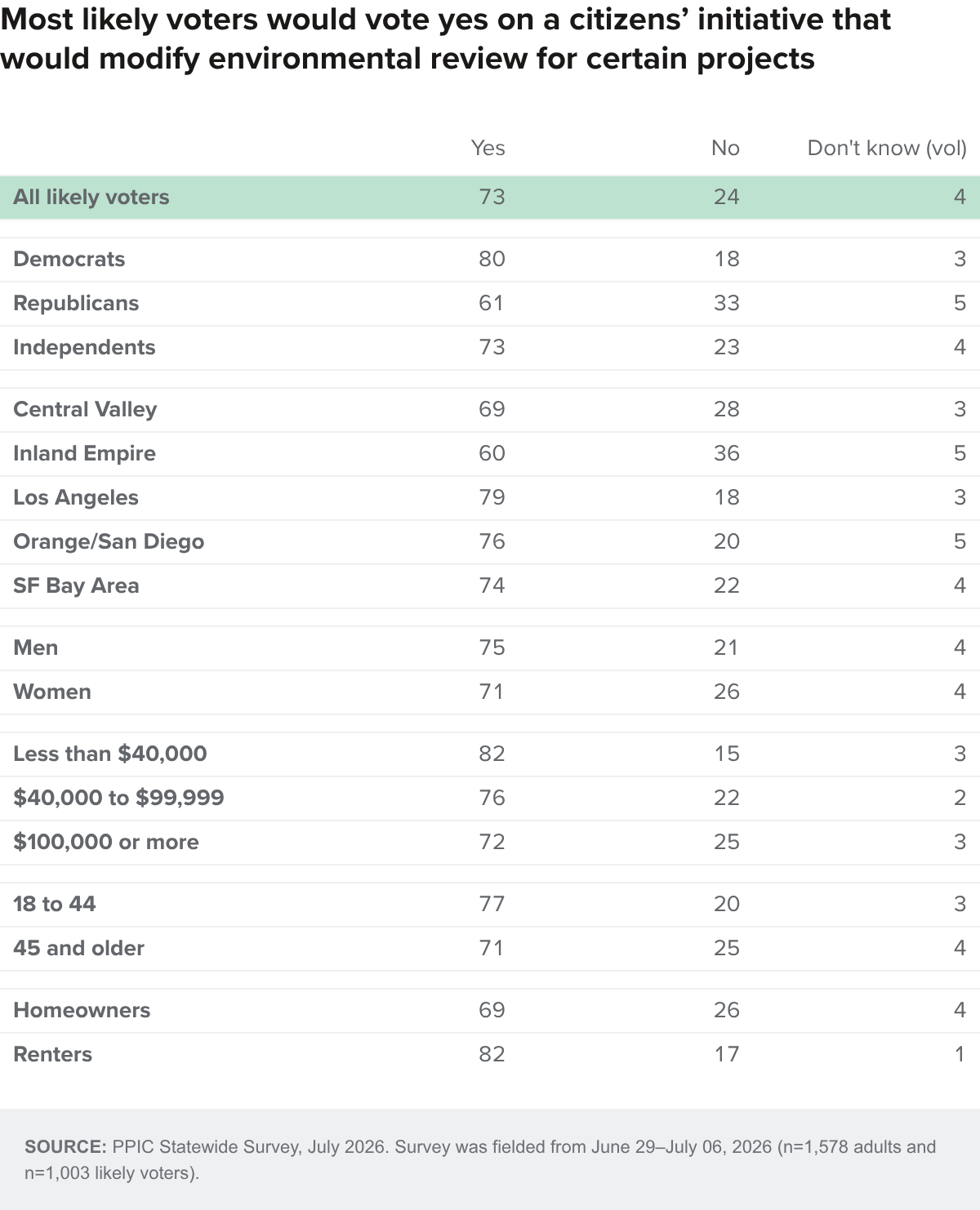
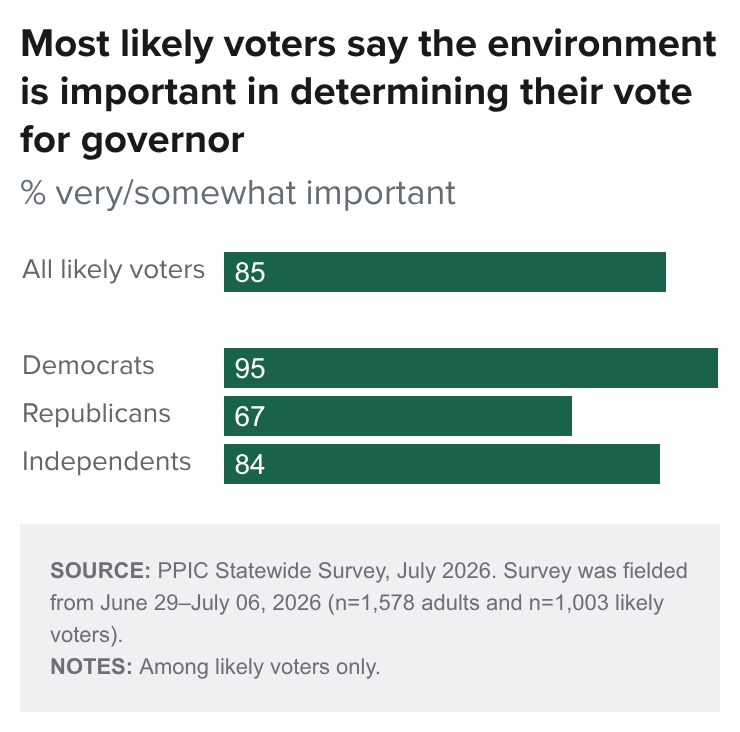 Xavier Becerra (D) leads Steve Hilton (R) by a wide margin (61% to 36%) in the governor’s race. Democratic candidates lead Republican candidates in local House district races (63% to 35%). A majority of likely voters say that candidates’ positions on the environment are important in determining their vote; Democrats are more likely to say the environment is very important. Seventy-three percent would vote “yes” on a citizens’ initiative that would amend the California Environmental Quality Act.
- About half approve of Governor Newsom while one in four approve of President Trump when it comes to their handling of environmental issues. Partisans are divided. About half approve of the California Legislature and one in five approve of the US Congress when it comes to their handling of environmental issues. Majorities across partisan groups disapprove of Congress. Forty-three percent of adults say they can trust the state government and 22 percent say they can trust the federal government either always or most of the time when it comes to environmental issues.
 Californians are most likely to name wildfires as the top environmental issue facing the state today, followed by climate change, government overregulation, and water supply. About six in ten think that the state and local governments are not doing enough to address wildfires. A majority believe that stricter environmental laws and regulations in California are worth the cost, while partisans are deeply divided. Two in three adults oppose the governor’s executive order banning the sale of all new gasoline-powered vehicles by 2035, while one in three say that they have seriously considered an electric vehicle the next time they buy or lease a vehicle. Majorities oppose construction of data centers in their area and worry about the environmental impact of building more AI data centers.
- Seventy-five percent of Californians think that the Global Solutions Act of 2006 that required California to reduce its greenhouse gas emissions has been mostly a good thing for California. Majorities of adults believe that the effects of climate change have already begun, and that they pose a serious threat to the economy and quality of life of California’s future. Fifty percent say that they are very concerned that home insurance will become more expensive due to climate change risks. About two in three favor the state government making its own policies separate from the federal government on climate change. Six in ten favor requiring that all electricity come from renewable energy by 2045, while six in ten are not willing to pay more for renewable energy.
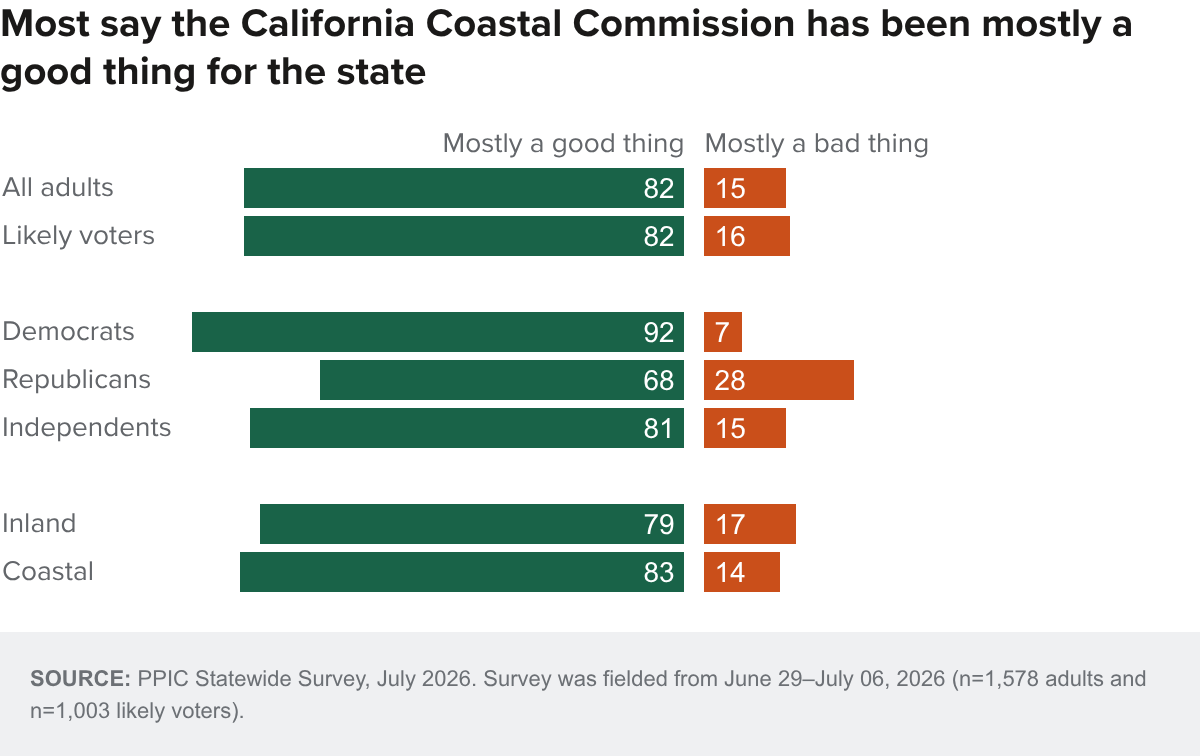
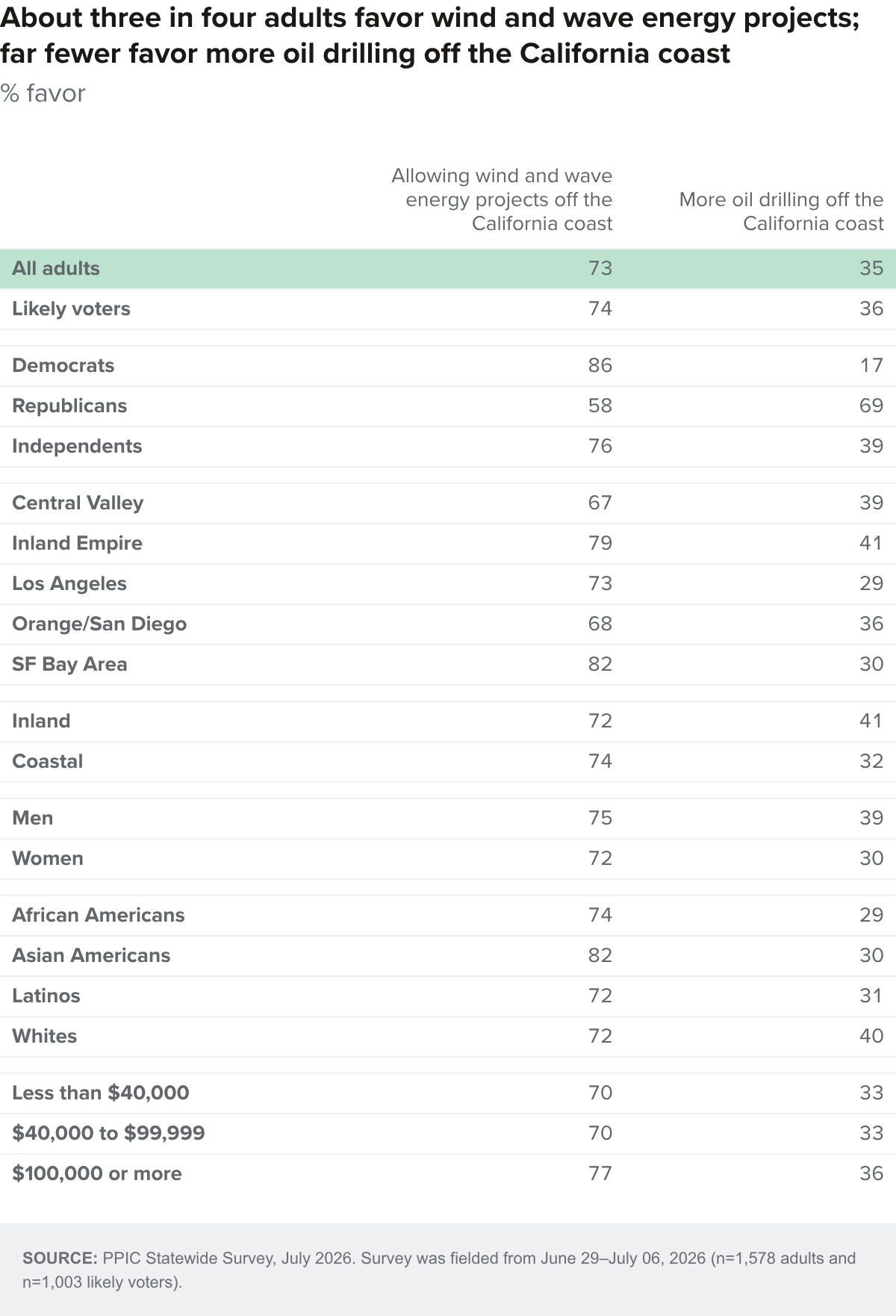
- Eighty-two percent of adults think the California Coastal Commission that was established permanently by the California Coastal Act of 1976 has been mostly a good thing for California. Large majorities continue to oppose more oil drilling off the California coast and favor wind power and wave energy projects off the California coast. Six in ten say that Marine Protected Areas are very important. Majorities report that plastics and marine debris and declining marine life are big problems on the coast that is nearest to them. Sixty-five percent say that the conditions of oceans and beaches are very important to the economy and quality of life for the state’s future.
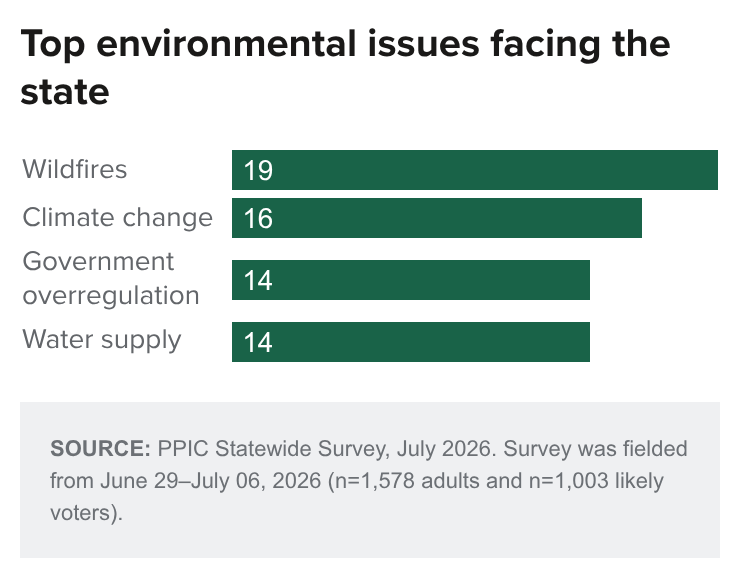 Californians are most likely to name wildfires as the top environmental issue facing the state today, followed by climate change, government overregulation, and water supply. About six in ten think that the state and local governments are not doing enough to address wildfires. A majority believe that stricter environmental laws and regulations in California are worth the cost, while partisans are deeply divided. Two in three adults oppose the governor’s executive order banning the sale of all new gasoline-powered vehicles by 2035, while one in three say that they have seriously considered an electric vehicle the next time they buy or lease a vehicle. Majorities oppose construction of data centers in their area and worry about the environmental impact of building more AI data centers.
November Election and Approval Ratings
This fall, California voters will be electing their next governor and US House members from political parties that hold starkly different views on environmental policies. Voters will also be asked to take sides on a state ballot measure that would ease the state’s environmental permitting process. How important are candidates’ positions on the environment in making choices, and how important is voting on environmental issues through the ballot initiative process? We examine the approval ratings of federal and state elected officials for their environmental policies in the midterm election context.
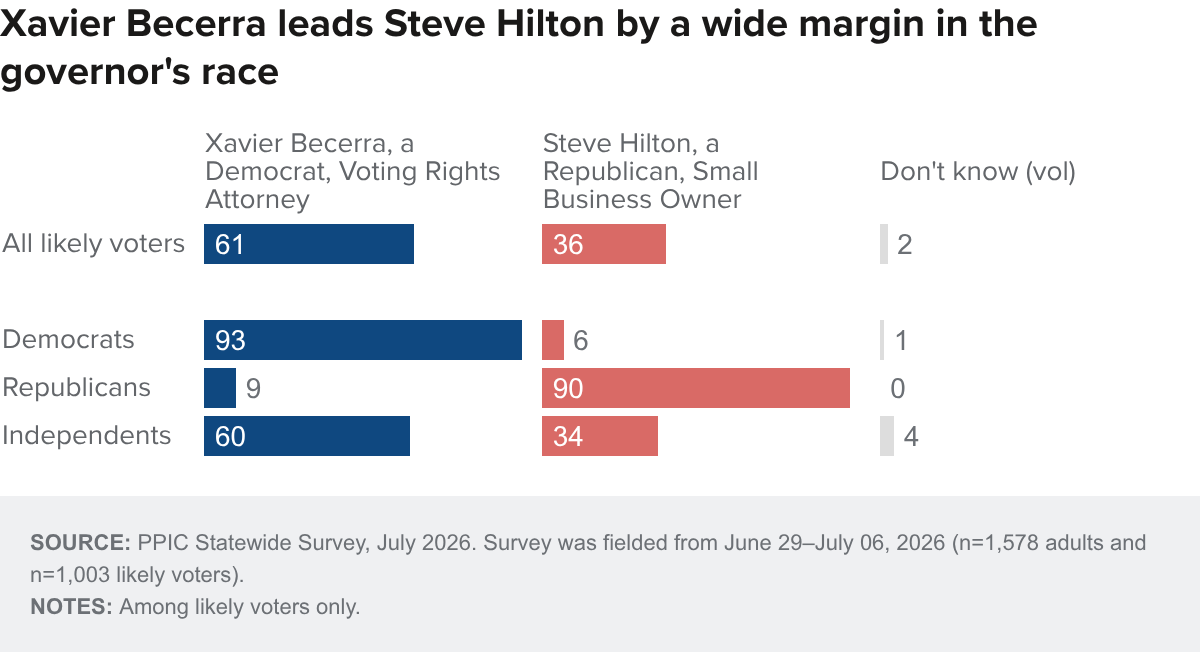
Gubernatorial Race. California likely voters say they would choose Xavier Becerra (D) over Steve Hilton (R) by a wide margin (61% to 36%) if the November election were held today. Today, partisans overwhelmingly support their party’s gubernatorial candidate: 93 percent of Democrats support Becerra, and 90 percent of Republicans favor Hilton, while independent voters lean toward the Democratic candidate (60% Becerra, 34% Hilton). Becerra leads Hilton across age, gender, homeownership, household income, and racial/ethnic groups, and across the state’s major regions.
Eighty-five percent of likely voters say that the gubernatorial candidates’ positions on the environment are important (48% very, 37% somewhat) in determining their vote. Majorities across partisan and demographic groups and regions of the state hold this view. Partisans are divided in how important this is: 60 percent of Democrats say the candidates’ environmental positions are “very” important, compared to 29 percent of Republicans and 44 percent of independents. Becerra supporters (59%) are far more likely than Hilton supporters (28%) to express this opinion. Before the 2022 election, a similar 87 percent of likely voters said that the gubernatorial candidates’ positions on the environment were important (45% very, 42% somewhat) in determining their vote.
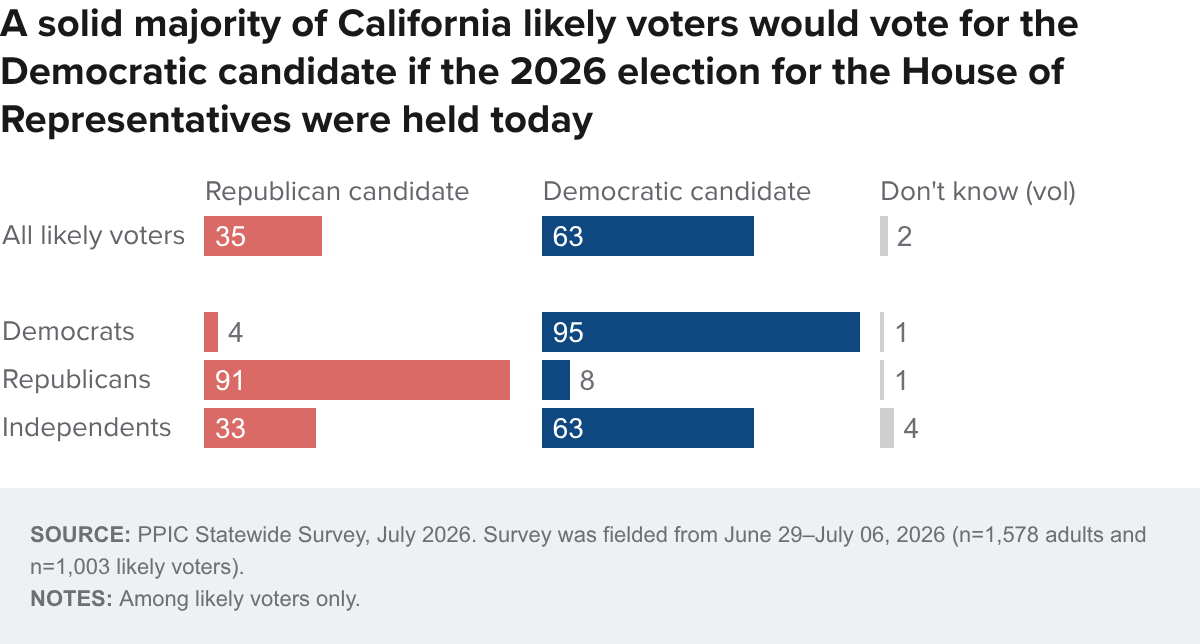
House Races. When asked about their House district race, most likely voters say they would vote for the Democratic candidate over the Republican candidate by a wide margin (63% to 35%). Likely voter preferences were similar in May (64% Democrat, 35% Republican) and February (62% Democrat, 36% Republican) and, for historical perspective, in May 2022 (55% Democrat, 35% Republican). Today, more than nine in ten Democratic and Republican likely voters would choose their party’s House candidate, and independents lean toward voting for the Democratic House candidate (63% to 33%). Majorities say that they would vote for the Democratic candidate over the Republican candidate in their House district races across state regions and demographic groups.
Eighty-one percent of likely voters say that House candidates’ positions on the environment are important (41% very, 40% somewhat) in determining their vote. Majorities across partisan and demographic groups and state regions hold this view. Partisans differ on whether environmental positions are “very” important to them (55% Democrat, 18% Republican, 37% independent). Those who say that they would vote for a Democratic candidate (53%) are far more likely than those who would vote for a Republican candidate (20%) in their House district race to express this opinion.
State Ballot Measure. Seventy-three percent of California likely voters say they would vote “yes” on a November ballot initiative to amend the California Environmental Quality Act (CEQA) to expedite environmental reviews for housing, transportation, water, health, and clean energy projects. (Note: the Proposition 45 ballot title and label were not available at the time of the survey launch.) Majorities would vote “yes” across partisan groups (80% Democrats, 61% Republicans, 73% independents), demographic groups, and state regions. Notably, eight in ten likely voters who have incomes of less than $40,000 and renters say they would vote “yes” on the CEQA reform initiative.
Ninety-one percent of likely voters say it is important (64% very, 27% somewhat) to vote on ballot measures that will make laws and change public policies about environmental issues in California. Overwhelming majorities have held this view in recent PPIC Statewide Surveys. Majorities across partisan and demographic groups and state regions hold this view; however, partisans vary in saying that voting on environmental issues is very important (71% Democrats, 54% Republicans, 61% independents).
Approval Ratings. About half approve of the way that Governor Gavin Newsom (51% adults, 53% likely voters) and the California Legislature (48% adults, 51% likely voters) are handling environmental issues in California. Partisans are deeply divided. Forty-three percent of adults and 46 percent of likely voters say that they can trust the state government “just about always” or “most of the time” to do what is right when it comes to handling environmental issues in California.
By comparison, fewer than three in ten approve of the way that President Donald Trump (25% adults, 28% likely voters) and the US Congress (19% adults, 18% likely voters) are handling environmental issues in the US. Partisans are divided in their approval of the president, while majorities across partisan groups say they disapprove of Congress. Twenty-two percent of adults and 19 percent of likely voters say that they can trust the federal government “just about always” or “most of the time” to do what is right when it comes to handling environmental issues in the US.
Environment, Economy, and Technology
Most Californians choose either wildfires (19%), global warming (16%), government overregulation (14%), or water supply (14%) as the most important environmental issue facing California today. Wildfires is the top issue across most major regions aside from the San Francisco Bay Area (21% climate change). Notably, nearly six in ten Californians (58%) say that state and local governments are not doing enough to address wildfires, including prevention and recovery. This view is shared by at least half of respondents across regions, parties, and demographic groups.
Majorities of adults (55%) and likely voters (57%) believe that stricter environmental regulations in California are worth the cost, while 43 percent of both adults and likely voters say these regulations cost too many jobs and hurt the economy. Majorities across regions and most demographic groups support stricter environmental regulations despite their economic costs, although opinions differ sharply by party. About three in four Republicans say environmental regulations hurt the economy, while eight in ten Democrats say they are worth the cost and independents are split.
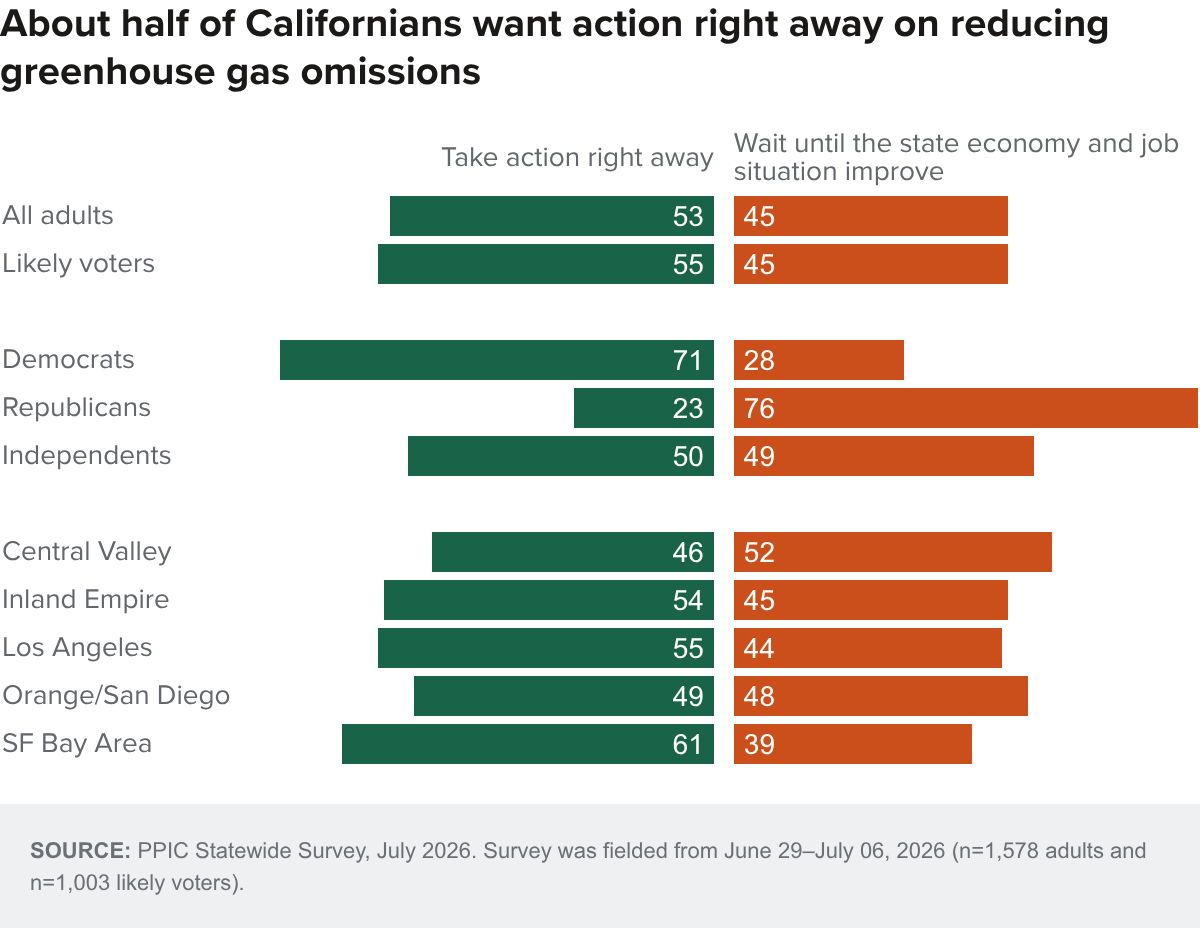
Californians have been feeling increasingly pessimistic about the economy. According to our May 2026 survey, 76 percent expected bad economic conditions in California over the next year. Despite this outlook, about half still prefer that the state take action immediately to reduce greenhouse gas emissions rather than wait for the economy to improve. Views vary somewhat across regions and demographic groups, with San Francisco Bay Area residents (61%) and adults ages 18 to 34 (60%) being the most likely to favor immediate action. Partisan differences are substantial: about three in four Republicans prefer waiting until the economy improves, while seven in ten Democrats support acting right away. Independents are almost evenly split on the issue.
Californians have somewhat mixed views about electric vehicles. Forty-five percent say they have either seriously considered purchasing (33%) or already own (12%) an electric vehicle, while 54 percent say they have not considered purchasing one. The share who say they have not considered purchasing an electric vehicle has increased since July 2023, when 41 percent reported that they had not considered doing so. Views vary across regions and demographic groups, with Republicans (70%), those with a high school diploma or less (68%), and Latinos (61%) among the most likely to have not considered purchasing an electric vehicle. Residents earning more than $100,000 annually are far more likely than those earning less to have either purchased or seriously considered purchasing an electric vehicle.
Only one in five Californians are extremely (5%) or very (15%) confident that the state will build sufficient infrastructure to support large numbers of electric vehicles on the roads; about a third (32%) are somewhat confident and nearly half are not too (24%) or not at all (22%) confident. Confidence is relatively low across parties, regions, and demographic groups.
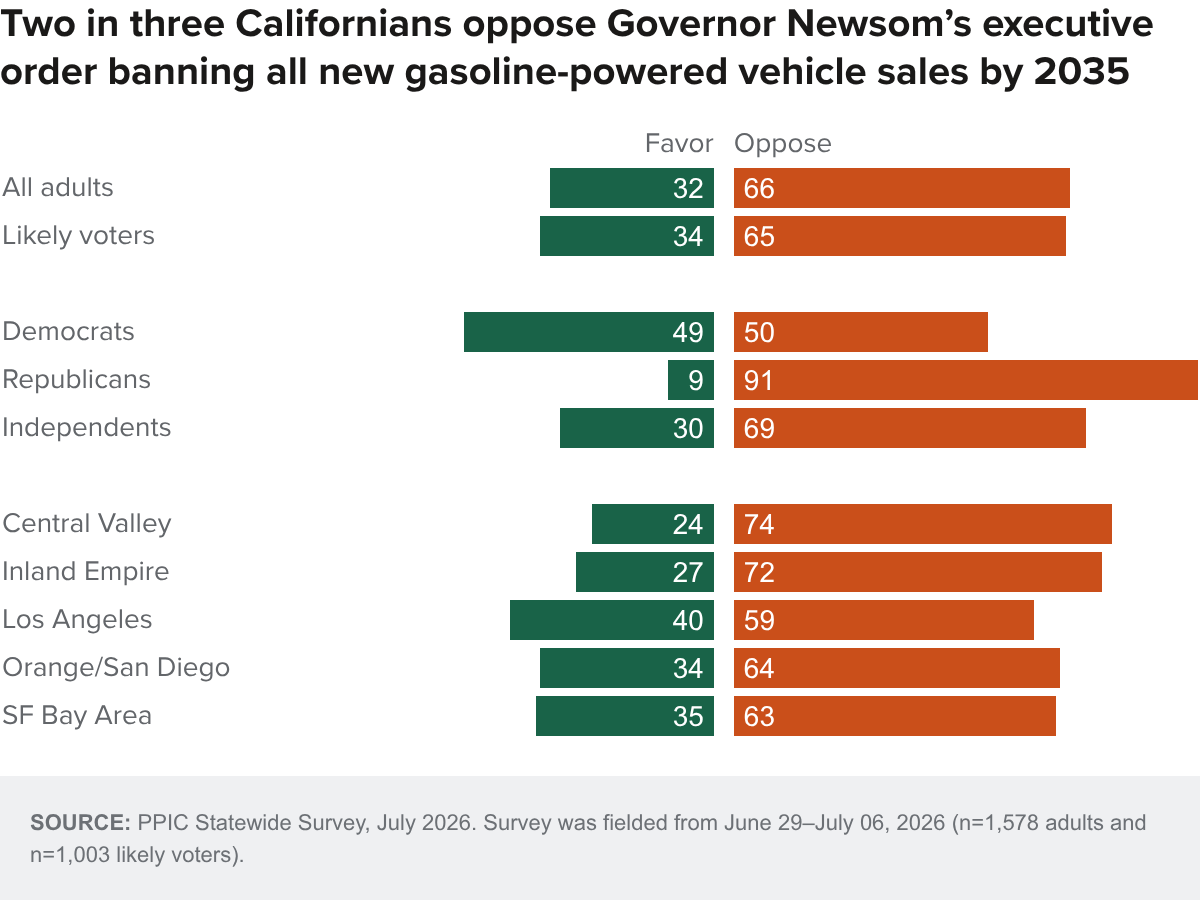
Nearly two in three adults (66%) and likely voters (65%) oppose Governor Newsom’s executive order banning the sale of all new gasoline-powered vehicles by 2035. This share of adults has increased 17 points since July 2021, when 49 percent of Californians opposed the executive order. Today, most Republicans (91%) and independents (69%) are opposed, while Democrats are split. About six in ten or more across regions and demographic groups oppose this executive order.
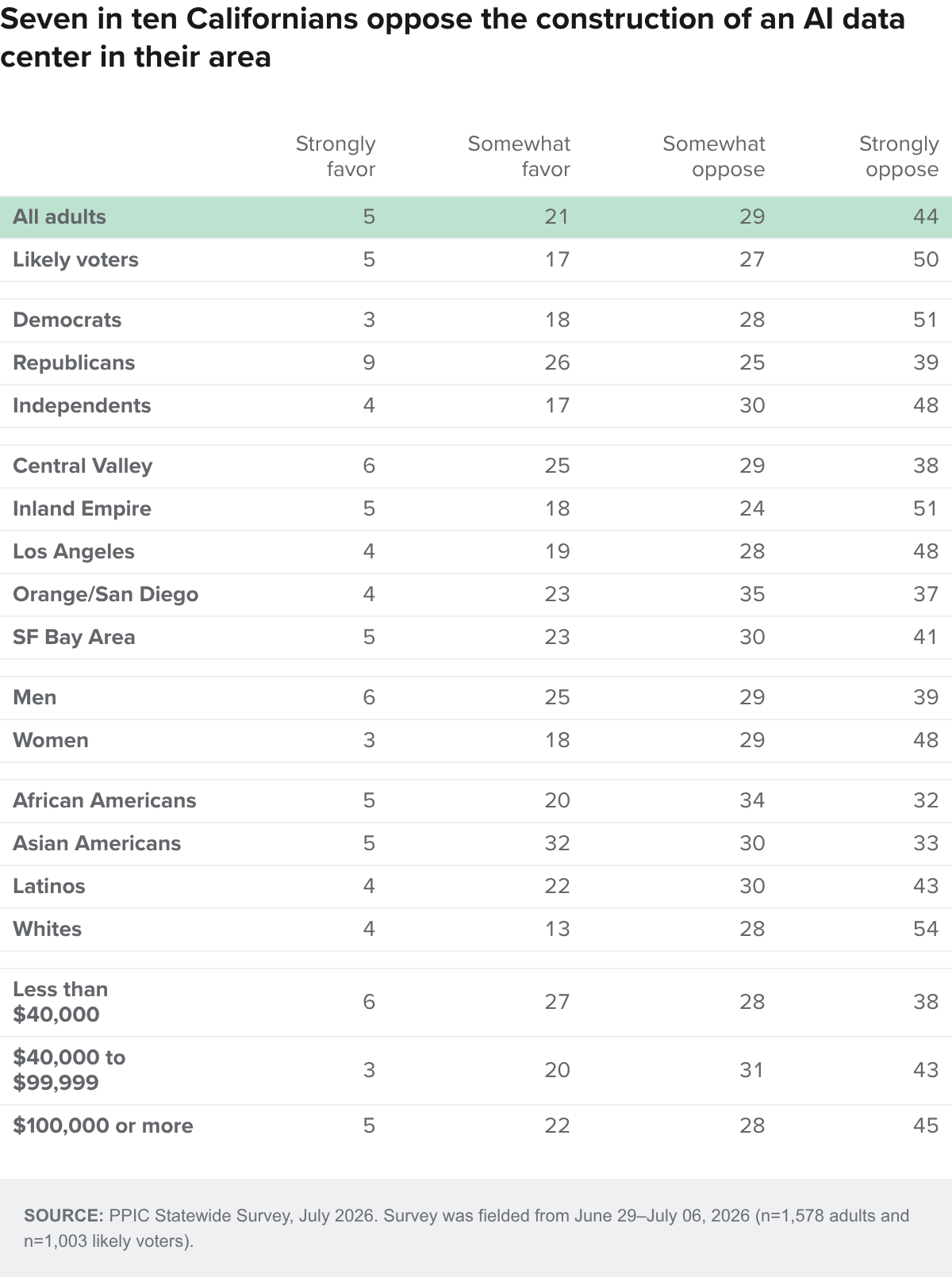
Overwhelming majorities of adults and likely voters oppose the construction of a data center in their area to support artificial intelligence technology (adults: 44% strongly, 29% somewhat; likely voters: 50% strongly, 27% somewhat). Only about a quarter favor the construction of a data center (adults: 5% strongly, 21% somewhat; likely voters: 5% strongly, 17% somewhat). While more than six in ten across political parties oppose data center construction, Republicans are slightly more likely to favor the idea than Democrats or independents. Across regions, strong opposition is highest in the Inland Empire (51%) and Los Angeles (48%), although at least two in three residents in every major region express at least some level of opposition. Views also vary by race and ethnicity, with more than half of white adults strongly opposing a data center in their area compared to about a third of Asian American and African Americans. Overall, about two in three across other demographic groups oppose building an AI data center in their area. According to a March 2026 Gallup survey, adults nationwide have similar views about AI data centers.
Strong majorities of adults and likely voters agree that they are worried about the environmental impact of building more AI data centers (adults: 42% strongly, 21% somewhat; likely voters: 48% strongly, 21% somewhat). About two in ten neither agree nor disagree (22% adults, 17% likely voters) that they are worried, and only 13 percent each of adults and likely voters say they are not worried. Majorities across all regions express concern about the environmental impacts of AI data centers. This concern is highest in the San Francisco Bay Area (68%) and lowest in the Central Valley (52%). Majorities across demographic groups are worried about these environmental impacts.
Climate Change and Energy
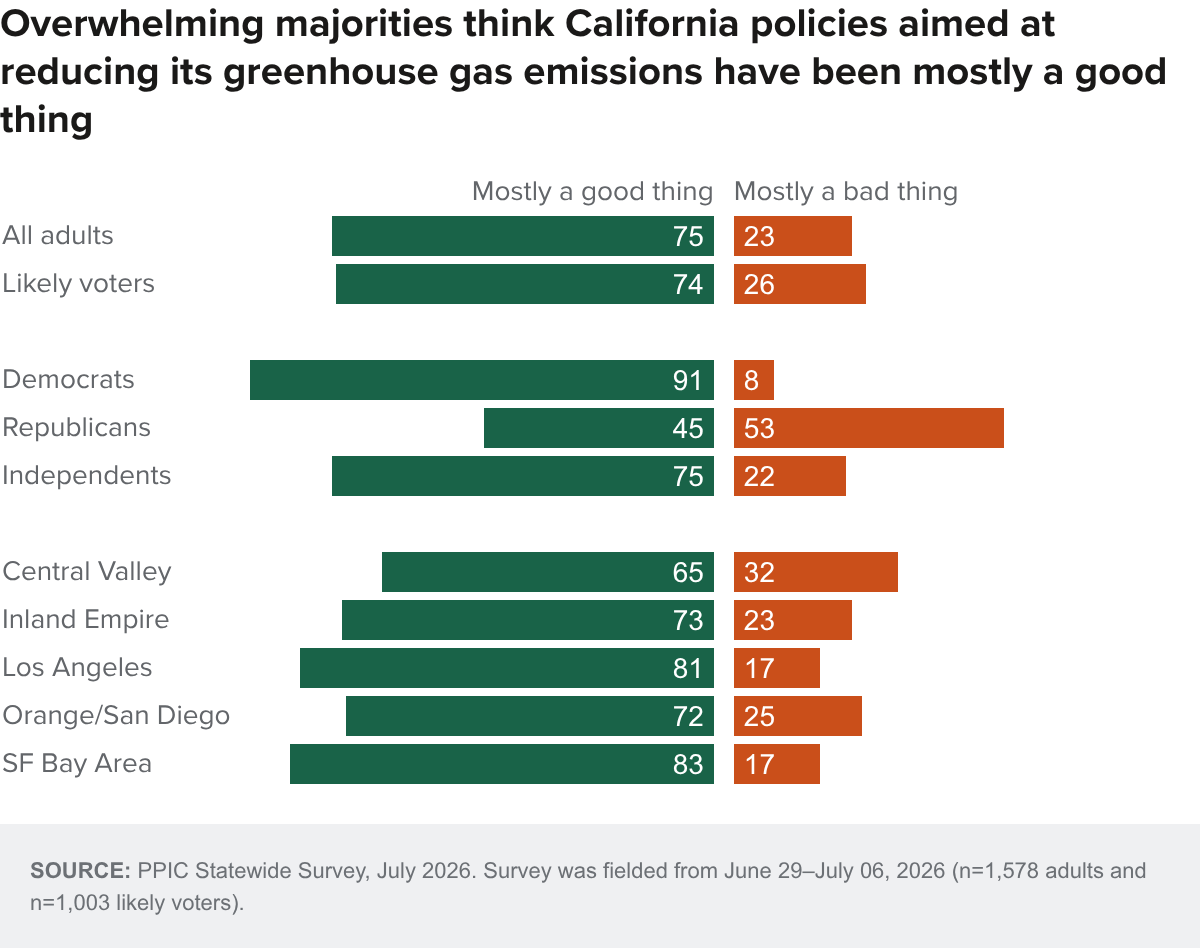
Two decades ago, California passed AB32, the Global Warming Solutions Act of 2006, requiring the state to reduce its greenhouse gas emissions to 1990 levels by the year 2020. This goal was achieved four years early and led to the current goal under SB32 to reduce greenhouse gas emissions to 40 percent below 1990 levels by 2030. When asked if passing AB32 and SB32 has been mostly a good thing or mostly a bad thing for the state, overwhelming shares of Californians say it has been mostly a good thing. Strong majorities across regions and demographic groups agree. Most Democrats and independents say these policies have been mostly a good thing, while a slim majority of Republicans say it’s been mostly a bad thing.
Most Californians (60%) think that the effects of climate change have already begun, while about one in five say they will not happen within their lifetime but will affect future generations (11%) or will never happen (10%). Additionally, about one in five say the effects will begin within a few years (4%) or within their lifetime (13%). Nearly eight in ten Californians say climate change is a very serious (41%) or somewhat serious (37%) threat to the economy and quality of life for California’s future. And 50 percent of Californians (57% homeowners) are very concerned that home insurance will become more expensive due to climate change risks.
A strong majority (65%) are in favor of California making its own policies separate from the federal government to address the issue of climate change. Notably, since 2005 majorities have said the effects of climate change have already begun and favored the state government acting on its own, while more than seven in ten have viewed climate change as a threat to the economy and quality of life for California’s future.
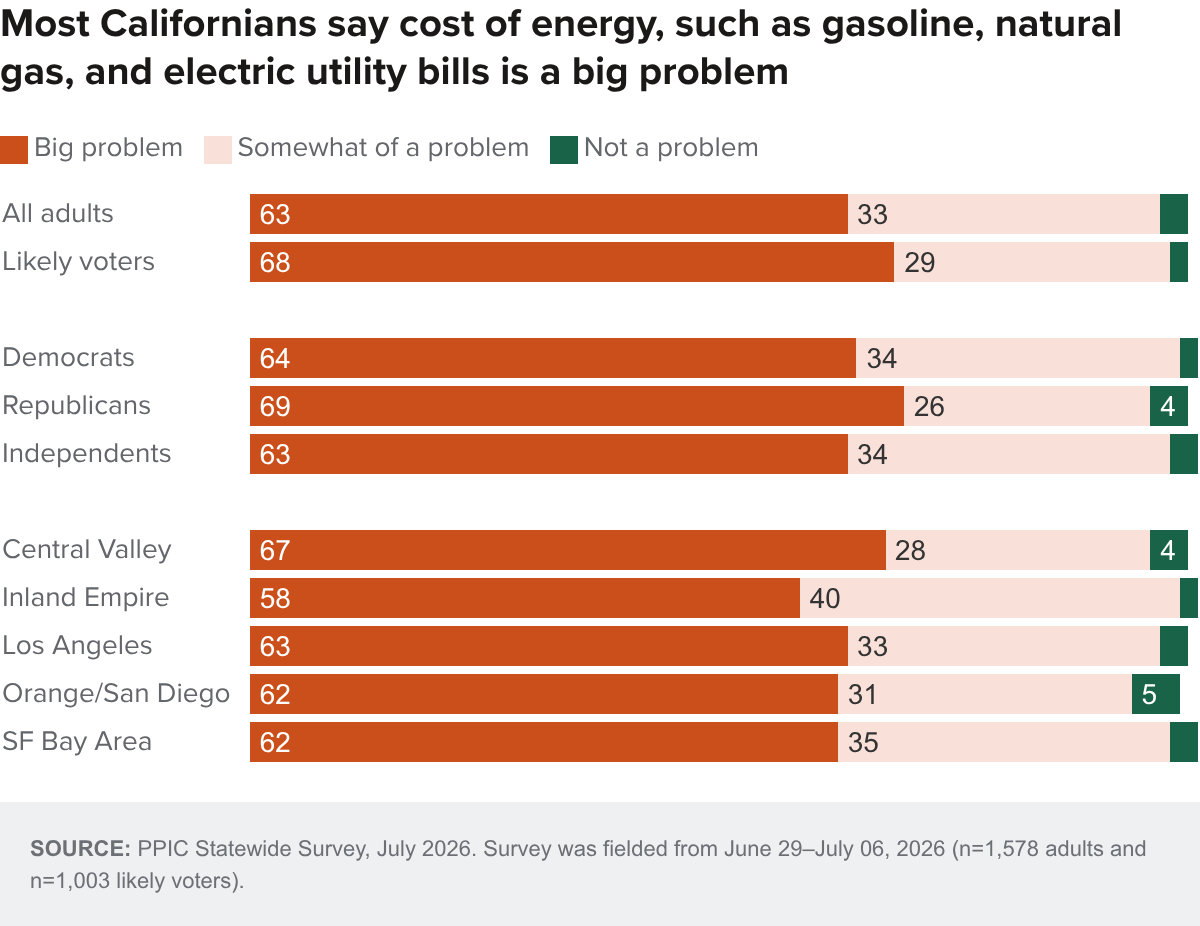
California’s actions to address climate change and limit greenhouse gases contribute to higher energy prices. About six in ten Californians (63%) say that the cost of energy, such as gasoline, natural gas, and electric utility bills, is a big problem in their part of California, and one in three say it is somewhat of a problem. The share calling this a big problem is up 9 points since last July. This view is widely held, with about six in ten or more across parties, regions, and demographic groups saying the cost of energy is a big problem. When asked specifically about the current price of gasoline at the pump, 63 percent say this is a major problem—an increase of 11 points since last July—while 27 percent say it is a minor problem and 9 percent say it is not a problem. Once again, there is widespread agreement, with six in ten or more across parties and regions and more than half across demographic groups saying the current price of gasoline is a major problem.
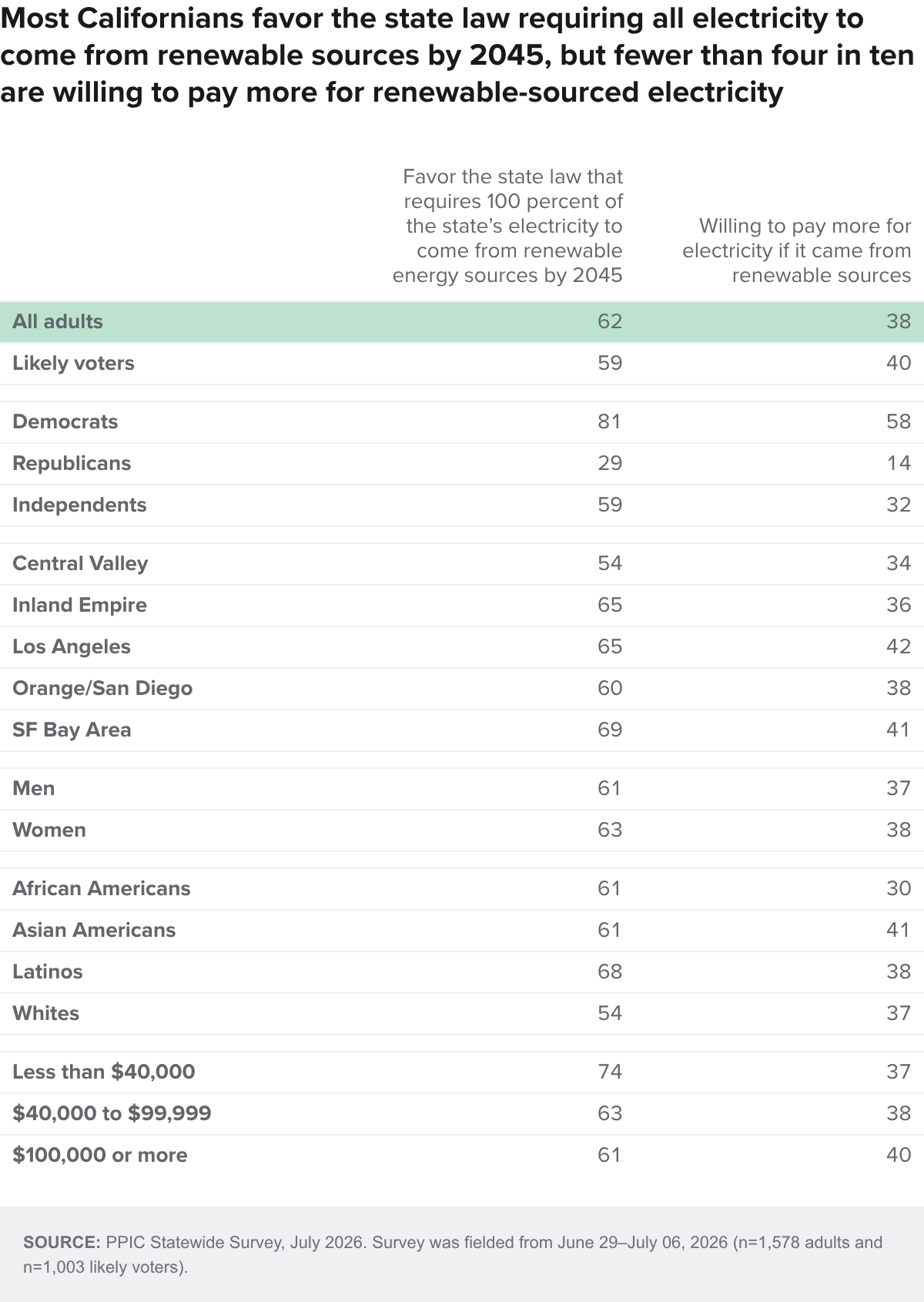
About six in ten adults (62%) and likely voters (59%) favor the state law that requires 100 percent of the state’s electricity to come from renewable energy sources by 2045, while a third or more adults and likely voters oppose it. Majorities have been in favor since the first time PPIC asked this question in 2018. There is a partisan divide on this state law, while majorities across demographic and regional groups favor it.
Although many support the shift to renewable energy, a solid majority of adults (60%) say they would not be willing to pay more for electricity if it came from renewable sources, such as wind and solar energy, while 38 percent say they would be willing to pay more. The share willing to pay more has exceeded 50 percent only once, in 2016 (56%). Today, a majority of Democrats are willing to pay more, while most independents and Republicans are not. Fewer than half across demographic and regional groups are willing to pay more.
Ocean, Coast, and Marine Life
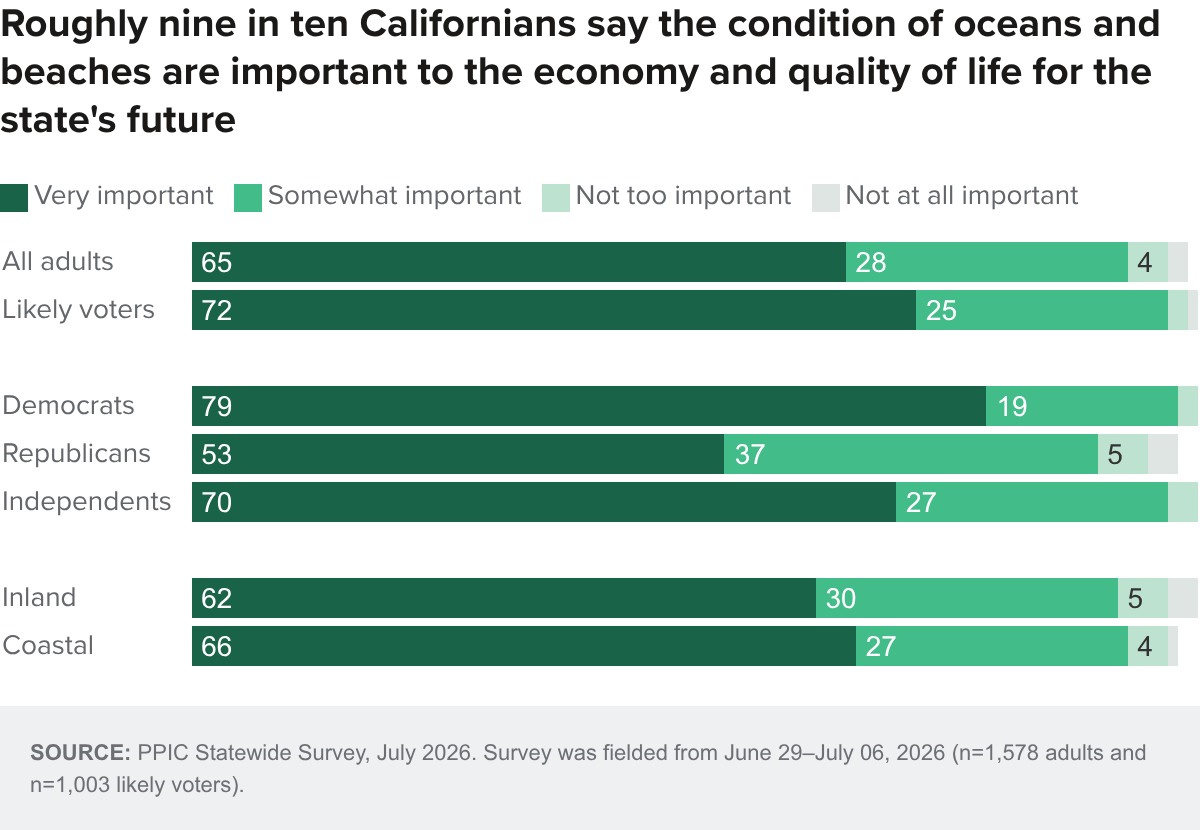
About nine in ten adults in the state believe that the conditions of oceans and beaches are very (65%) or somewhat (28%) important to the economy and quality of life for California’s future; very few say it is not too (4%) or not at all important (2%). Overall shares are somewhat similar among likely voters, and the share of adults saying this is very important has risen steadily since July 2024 (57%). Today, majorities across partisan, regional, and demographic groups say this is very important. Coastal and inland residents are about equally as likely to say this.
Nine in ten adults (40% big problem, 50% somewhat) say ocean and beach pollution is at least somewhat of a problem along the California coast, and shares are similar to last year. Fewer than half across partisan groups say this is a big problem, but Democrats (48%) are more likely than independents (40%) and Republicans (30%) to say this. Views vary across regional and demographic groups. Across racial/ethnic groups, Latinos (47%) and African Americans (46%) are most likely to say this is a big problem, compared to about one in three Asian Americans (32%) and whites (33%). Views among inland and coastal residents are somewhat similar.
When it comes to plastics and marine debris along the California coast, another nine in ten adults (65% big, 30% somewhat) say that it is at least somewhat of a problem. These shares were similar a year ago. Views vary across partisan, demographic, and regional groups. Latinos (71%) are the most likely across racial/ethnic groups to say this is a big problem, while African Americans are least likely (54%; 64% Asian Americans, 63% whites). Views among inland and coastal residents are similar.
An overwhelming majority of adults say Marine Protected Areas (MPAs), which are managed by the California State Fish and Game Commission to protect fish, wildlife, and their habitats in coastal waters, are very (59%) or somewhat (31%) important. Today, most Democrats (72%) and independents (61%) say MPAs are very important, compared to 45 percent of Republicans. Half or more across demographic and regional groups say this; however, coastal residents (62%) are somewhat more likely than inland residents (54%) to hold this view.
Seven in ten adults say limited beach access is at least somewhat of a problem (21% big, 50% somewhat) in the part of the California coast closest to them. The share saying this is a big problem was similar in July 2022 (21%), the last time PPIC asked this question. Today, two in ten across partisan groups say this is a big problem. About two in ten or more across demographic groups say this except for Asian Americans (14%). The share holding this view is highest in Los Angeles (26%) and lowest in the San Francisco Bay Area (15%) (Orange/San Diego: 22%, Central Valley: 21%, Inland Empire: 19%).
About eight in ten say the California Coastal Commission (CCC)—a state agency that was established by the California Coastal Act in 1976 and is responsible for regulating land use, protecting the environment, and managing public beach access across roughly 1,100 miles of coastline—has been mostly a good thing for the state; one in six say it has been mostly a bad thing. There is broad partisan support for the California Coastal Commission, and overwhelming shares across demographic and regional groups say it has been mostly a good thing.
About three in four adults and likely voters favor allowing wind power and wave energy projects off the California coast, and about a quarter oppose. Support for wind and wave energy projects has been overwhelming since July 2017 (73%). Today, majorities across partisan, demographic, and regional groups are in favor. Shares are similar among inland and coastal residents.
However, when it comes to allowing more oil drilling off the California coast, the share in favor falls to fewer than four in ten among adults and likely voters; about six in ten oppose. The share opposing is similar to a year ago, and majorities have opposed since 2013. Partisans are divided on this issue, while about four in ten or fewer across demographic and regional groups support more oil drilling off the California coast.
Topics
2026 Election Forests and Fires Political Landscape Statewide Survey Water Supply Water, Land & Air